
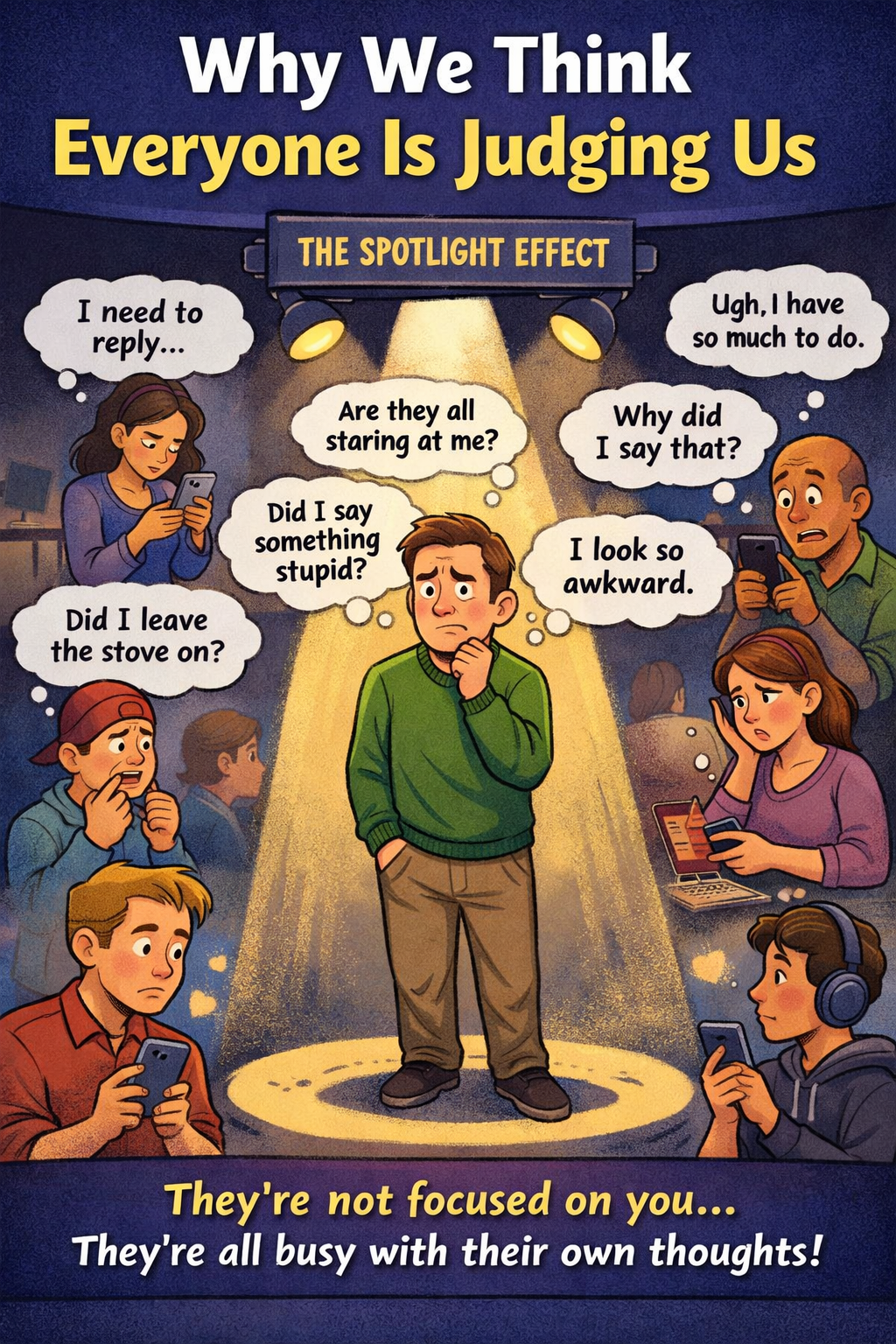
Why We Think Everyone Is Judging Us…And why they usually aren’t
Most of us are walking around stuck on a thought…
People are watching me.
They notice when I say something awkward.
They notice when I stumble over my words.
They notice when I do something a little off.
It feels like there’s a spotlight on us at all times, just highlighting every tiny mistake.
There’s actually a name for this: the spotlight effect.
It’s the tendency to wildly overestimate how much other people are paying attention to us.
But here’s the reality that’s both humbling and freeing:
Most people are way too busy thinking about themselves.
They’re replaying their own conversations.
Thinking about their own stress.
Wondering if they sounded weird five minutes ago.
Everyone else is standing in their own spotlight.
Think about the last time someone said something a little awkward around you.
You probably noticed… for like two seconds.
Then your brain moved on.
Back to your life. Your thoughts. Your stuff.
But when it’s you?
That same moment becomes a full-blown highlight reel.
Why did I say that?
Did that sound dumb?
I shouldn’t have said that…
And suddenly a 10-second moment turns into a 10-hour mental loop.
What’s interesting is… that loop usually has way more to do with us than the situation.
When anxiety is high, the spotlight gets brighter.
When confidence is low, everything feels more exposed.
But when people start to feel a little more grounded in themselves, something shifts.
They stop performing.
They stop monitoring every word.
They just… exist in the moment.
And ironically, that’s when they become easier to connect with.
Not because they suddenly got better socially.
But because they stopped trying so hard.
So how do you actually push through the spotlight effect?
Not by trying to “be perfect.” That just feeds it.
Instead:
1. Shrink the audience in your head
Remind yourself: No one is analyzing me the way I’m analyzing me.
Literally say it if you need to.
2. Let the moment be awkward
Don’t fix it. Don’t over-explain.
Most of the time, the recovery is worse than the moment.
3. Shift your focus outward
Ask a question. Get curious about the other person.
Attention is like a flashlight—you can aim it away from yourself.
4. Stop the replay early
Catch it when your brain starts looping:
“Yep, that happened. Moving on.”
You don’t need a full post-game breakdown.
5. Practice being seen imperfectly
This is the real work.
Say something slightly messy. Be a little off. And… survive it.
That’s how the spotlight loses power.
The weird truth is this:
When you stop worrying so much about how you’re coming across…
You actually come across better.
More relaxed.
More natural.
More you.
And that’s what people connect with anyway.
Not perfection.
Just presence.