
When Schools Feel Too Loud for Quiet Kids
Last month, while visiting another school outside our district, I noticed a student sitting alone at the end of a cafeteria bench.
The room was loud — the kind of everyday school noise that blends together:
trays clatter, sneakers squeak, excited voices compete, announcements crackle overhead.
He wasn’t crying.
He wasn’t acting out.
He wasn’t asking to leave.
He was just making himself very small — shoulders curled, head down, hands lightly over his ears — as if shrinking would make the world quieter.
When I sat near him, he whispered:
“It’s too loud in my head.”
And that sentence hasn’t left me since.
🧠 Schools Run Loud — But Not Every Child Does
Many children thrive in busy, buzzing energy.
Group work lights them up.
They make friends in seconds.
Noise feels like life.
Other children — especially those who are:
introverted
anxious
sensory-sensitive
gifted deep-thinkers
or who simply take longer to warm up socially
…may not show overwhelm externally.
Instead, they absorb it.
Their coping strategy is often:
be quieter
be smaller
take up less space
They don’t disrupt the room —
so they’re easy to miss.
But silence is not the same thing as regulation.
Sometimes silence is protection.
🧬 Why “Normal” Noise Can Feel Big
From a brain-science perspective:
When sensory input becomes too much to process comfortably, the nervous system shifts into survival mode — even if no one around notices.
That can look like:
zoning out
daydreaming
avoiding eye contact
refusing to join a group
perfectionism (“If I can control this, I can breathe.”)
It’s easy to assume:
“If nothing is wrong, everything must be fine.”
But many quiet children aren’t disengaged —
they’re simply overstimulated and trying to cope.
🌱 The Goal Isn’t To Change Who They Are
Quietness is not a deficit.
It is a temperament.
A nervous system preference.
A beautiful way of being in the world.
Our job — as adults — isn’t to make kids louder.
It’s to make sure they don’t feel like they have to be louder in order to belong.
🏫 What Adults Can Do — At School and At Home
Supporting quiet children doesn’t require big programs or major changes.
Small moments send powerful messages.
🏫 In Schools
1️⃣ Offer Predictability Before Participation
“Today we’ll share in pairs.”
“You can choose how you participate.”
2️⃣ Give Multiple Ways to Contribute
Talking is not the only form of engagement.
Writing, drawing, typing, or whisper-sharing count.
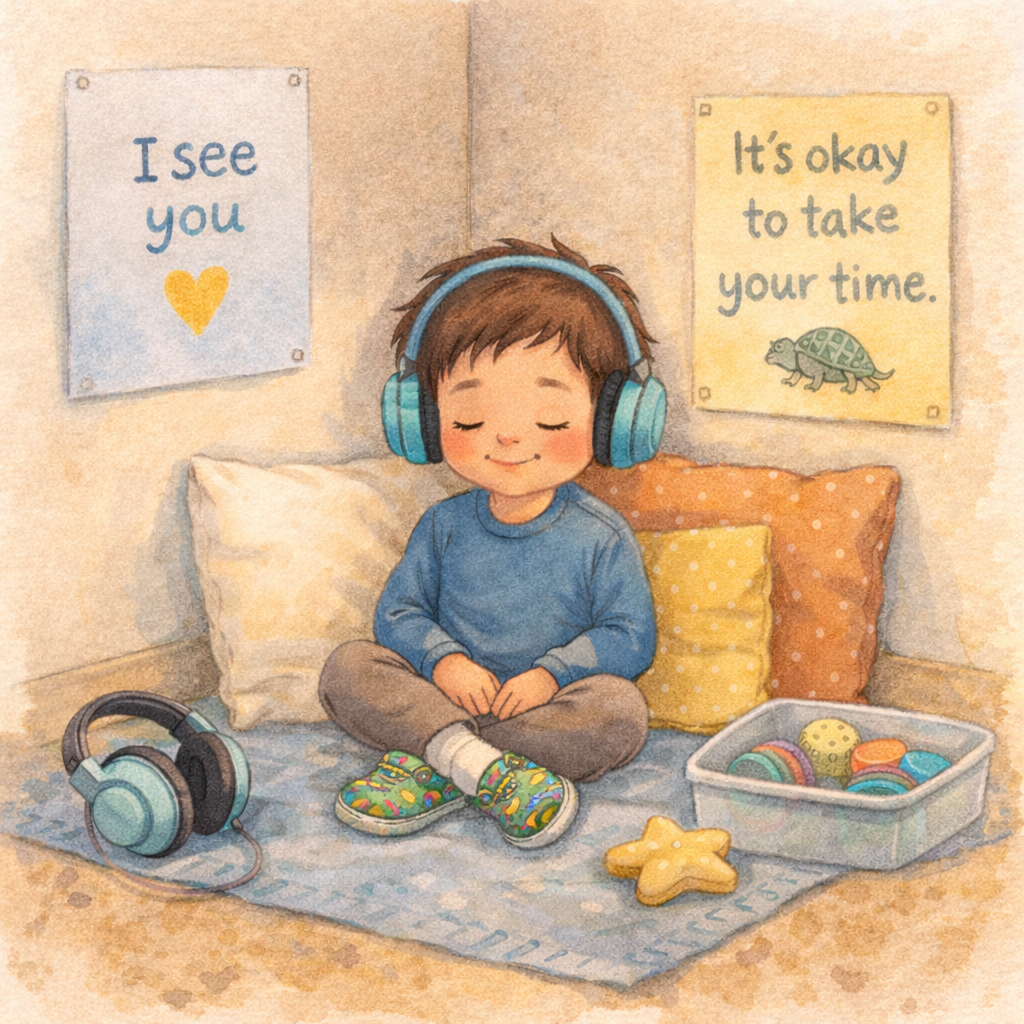
3️⃣ Create Micro-Spaces for Regulation
A window seat, beanbag, quiet table —
a 60-second pause can reset a whole nervous system.
🏠 For Parents — Support at Home
Quiet children often feel most themselves where they feel most safe.
Here’s what helps at home:
1️⃣ Protect a Daily Quiet Pocket
It doesn’t need to be long —
10 minutes of calm is enough to signal safety.
Reading, Legos, coloring, sitting together on the couch.
2️⃣ Narrate Their Strengths Out Loud
Say what you see — without trying to change it.
“You notice details others miss.”
“You take your time, and that’s a strength.”
3️⃣ Practice Consent-Based Socializing
Instead of:
“Go say hi — don’t be shy!”
Try:
“Would you like me to go with you first?”
or
“You can join when you’re ready.”
4️⃣ Ask the Smallest Question
At night, instead of:
“How was school?”
Try:
“What moment felt big today?”
Quiet kids answer better when questions get smaller.
👂 What Quiet Kids Long For Most
When I asked that student if he wanted to move to a quieter spot, he said:
“No… I just want someone to notice.”
Quiet kids don’t always need escape.
They don’t always need fixing.
Sometimes — they just need someone to see them.
🧩 A Gentle Invitation
This week, notice the child who:
lingers at the back of the line
packs slowly
listens more than they speak
folds into themselves when spaces get loud
And offer one supportive sentence:
“It’s okay to take your time.”
Because quiet is not the absence of strength —
it’s often where strength begins.