

How to Make the Most of the Upcoming Summer Break
Summer is starting, and I think a lot of us hit this time of year expecting ourselves to magically feel relaxed and happy the second life slows down.
And at first, it does feel good.
The alarms ease up.
The calendar opens up.
There’s finally room to breathe again.
But something weird also happens with too much unstructured time: days start disappearing.
You wake up, scroll a little, run an errand, watch something, maybe tell yourself you’ll do something “tomorrow,” and suddenly it’s somehow mid-July.
None of that is bad, by the way. Rest matters. A lazy day is not a wasted day. I think people forget that sometimes.... especially me !
But I do think summer feels better when at least some of it is intentional.
Not packed.
Not over-scheduled.
Just… a bit... purposeful.
The summers people remember usually aren’t the ones where they optimized every second. They’re the ones where they were actually present for parts of it.
A random concert.
Late-night talks on a patio.
Learning something for no reason other than curiosity.
Reading outside.
Road trips.
Morning walks.
Starting a project you may or may not finish.
Actually texting the friend you keep saying you miss.
Small things, but real things.
I’ve been thinking lately that a pretty good framework for summer is probably just:
Rest a little.
Connect a little.
Grow a little.
Sleep in sometimes.... I mean I'm going to try for 6:30
See people you care about.
Try something new.
Get outside more.
Let your brain breathe for a minute.
You don’t need to “win” summer.
You also don’t need to accidentally sleepwalk through it either.
Because time is strange like that. The older you get, the faster it seems to move. And I think part of that is because routines make weeks blur together.
Presence slows things down.
Attention slows things down.
So this is probably my reminder to myself as much as anybody else:
Don’t let the whole summer happen in the background.
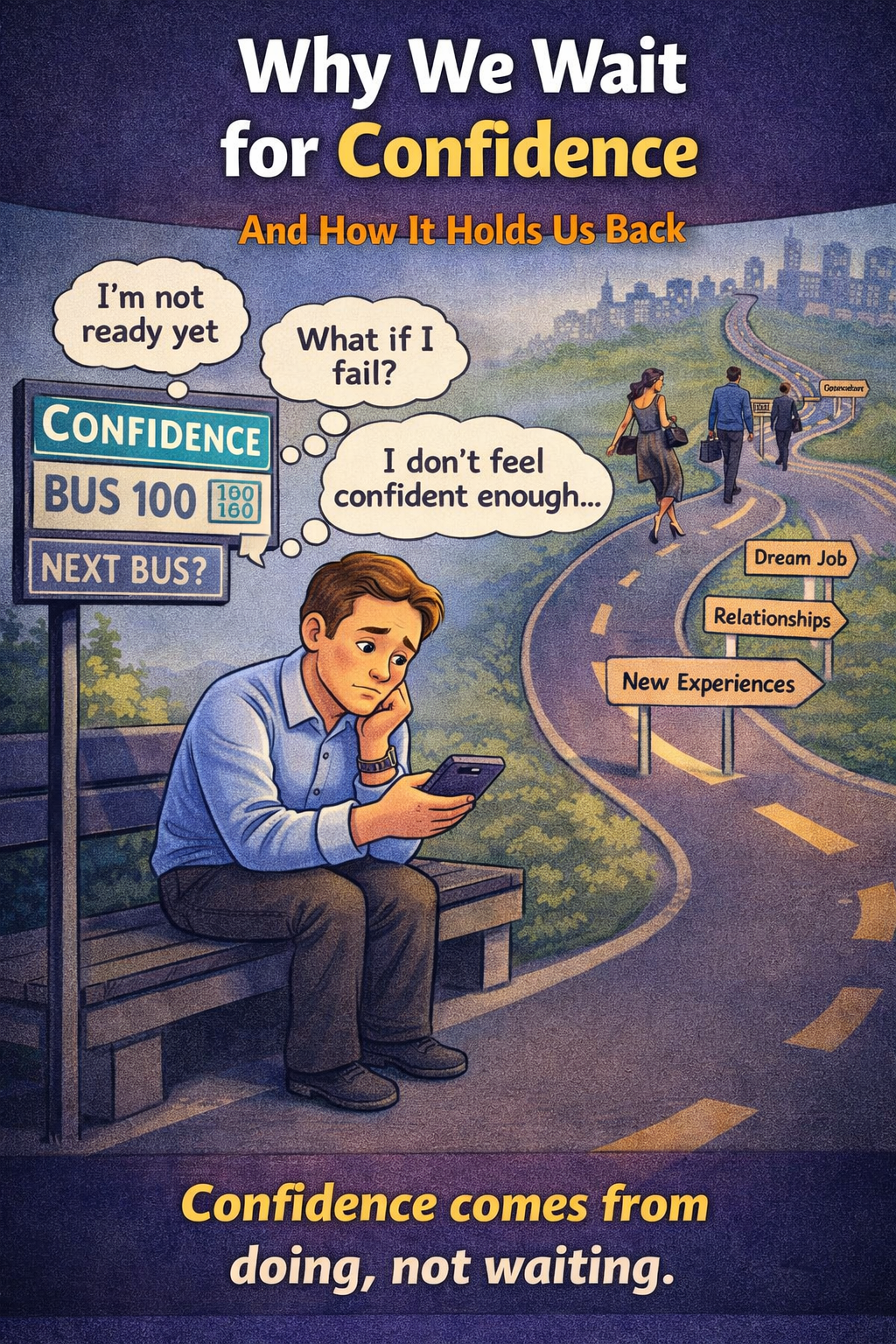
Why Waiting for Confidence Doesn’t Work
A lot of people believe confidence is something you’re supposed to feel before you act. The idea is that once you finally feel ready, once those nerves calm down and your brain gives you the green light…then you’ll take the step. You’ll speak up in the meeting, try something new, start the project, or have the conversation you’ve been avoiding. It sounds nice in theory, but in real life, that’s almost never how it works.
Confidence doesn’t usually show up first. It tends to come after we act, not before.
I was reminded of this the first time I played live music in front of people. It wasn’t some massive crowd, but in my head it might as well have been a stadium. I remember standing there with sweaty hands, overthinking every note, and feeling completely unprepared. There was no moment where I suddenly felt confident. No internal voice saying, “You’ve got this.” If anything, it was the opposite, my brain was actively suggesting I pack up and disappear. But I played anyway. It wasn’t perfect (honestly, parts of it were objectively rough), but I got through it. And that experience, messy as it was, mattered more than any amount of mental preparation I could have done beforehand.
That’s the part people miss. Confidence isn’t something your brain hands you in advance as a reward for thinking hard enough. It’s something your brain builds through evidence. Each time you do something uncomfortable and survive it, your brain takes note. “Okay, we tried that. It wasn’t ideal, but we didn’t fall apart. Maybe we can handle that again.” Over time, those small moments stack up, and eventually your brain starts to trust you, not because things feel easy, but because you’ve proven you can handle difficulty.
If you think about learning anything new, playing guitar, driving a car, giving a presentation, no one starts confident. The first attempts are almost always awkward and clumsy. You hesitate, you overthink, you make mistakes. That’s not a sign that something is wrong; that is the process. The problem is that many people interpret that discomfort as a signal to stop, when in reality it’s just a normal part of learning.
This is why waiting to feel confident can keep people stuck for a long time. The feeling they’re waiting for usually doesn’t arrive until after they’ve already started. It’s a bit like waiting to feel in shape before going to the gym—it sounds logical, but it completely reverses how growth actually works.
From a psychological standpoint, confidence is less about emotion and more about memory. Your brain is constantly scanning past experiences and asking, “Have we done something like this before, and did we make it through?” Every time the answer is yes, even a shaky, imperfect yes, it strengthens your sense of capability. Over time, that repeated exposure builds something more durable than a temporary feeling: it builds trust in yourself.
That’s why confident people aren’t necessarily less anxious or more certain. They’ve just accumulated more experiences where they’ve handled discomfort and come out the other side. They don’t expect things to feel easy; they trust that they can figure things out when they’re hard.
So confidence isn’t the absence of nerves, self-doubt, or awkwardness. It’s the belief that those things won’t overwhelm you. And that belief isn’t something you think your way into, it’s something you build through action.
If there’s something you’ve been putting off because you’re waiting to feel more confident, it might be worth flipping the approach. Instead of asking, “How do I feel ready?” the better question is, “What’s one small version of this I could try right now?” Not perfectly, not flawlessly, just enough to give your brain a new piece of evidence.
Because in the end, confidence doesn’t come from waiting. It comes from showing up, doing the uncomfortable thing, and realizing, again and again, that you’re more capable than your brain initially gives you credit for.
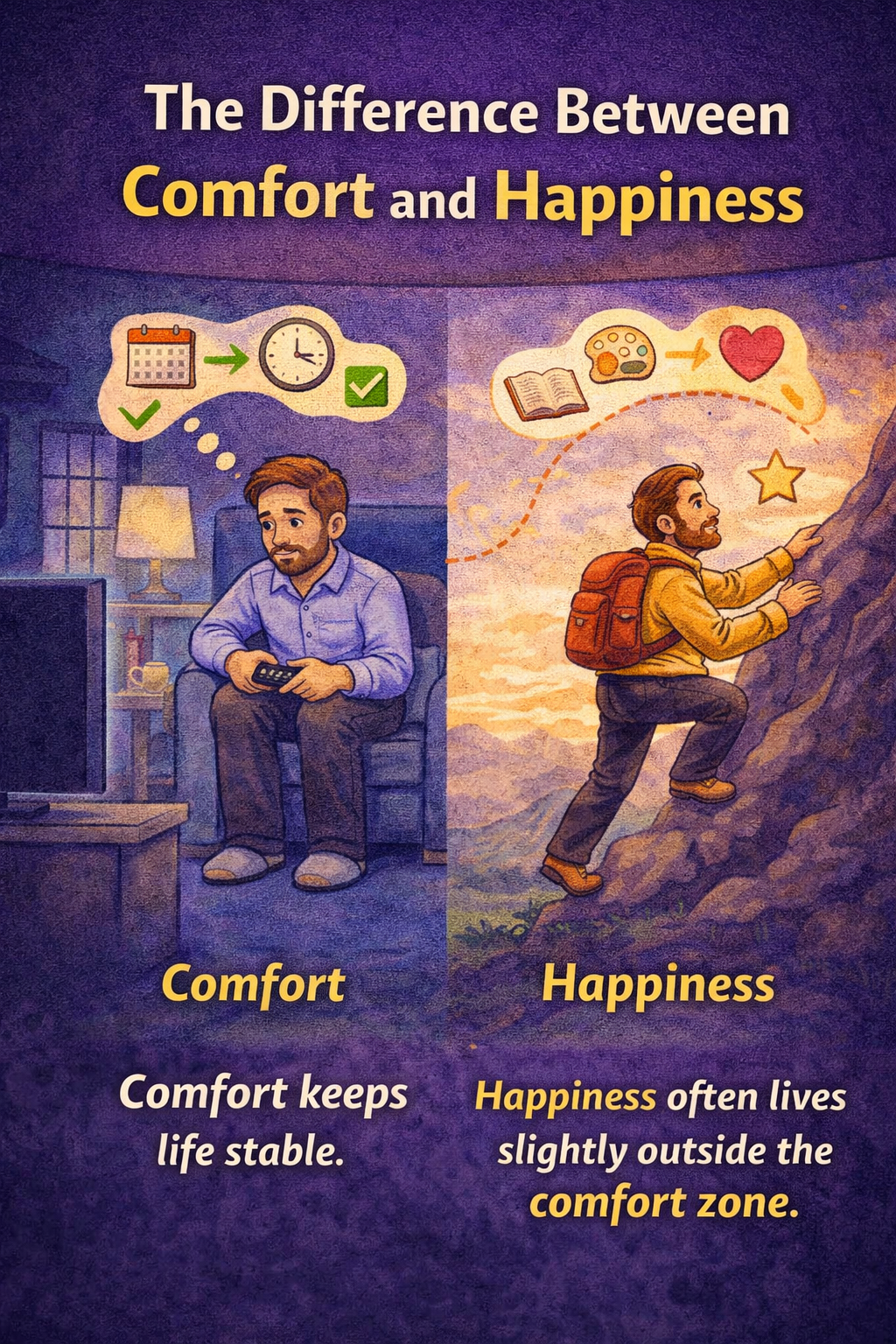
The Difference Between Comfort and Happiness
Comfort and happiness often look the same from the outside.
A routine.
A familiar place.
A life that feels steady and predictable.
But psychologically, they’re very different experiences.
Comfort feels safe.
It’s the same breakfast order.
The same drive.
The same conversations.
The same environments where you already know how things will go.
Comfort protects you from stress.
And there’s nothing wrong with that.
We all need places in our lives where we can relax and not have to think so much.
But happiness doesn’t really come from staying there.
Happiness tends to show up when we move toward something that matters.
Trying a new food.
Traveling somewhere unfamiliar.
Starting a conversation with someone you wouldn’t normally talk to.
Learning something new.
Putting yourself in a situation where you don’t quite know how it’s going to go.
Those moments don’t feel comfortable.
They feel uncertain.
Sometimes awkward.
Sometimes even a little stressful.
And that’s where people can get stuck….
Because when something feels uncomfortable, the brain is quick to say:
“Something’s wrong!” “Don’t do this!
But a lot of the time, nothing is wrong.
You’re just doing something new.
You’re stretching.
You’re stepping outside of what’s familiar.
And that feeling… the slight discomfort, the uncertainty… is often the exact space where growth happens.
Comfort keeps life stable.
But too much comfort can slowly make life feel smaller.
The days start to blur together.
Nothing feels especially bad… but nothing feels especially exciting either.
Happiness usually lives just outside that space.
Not in chaos.
Not in constant stress.
Just a little beyond what you’re used to.
It’s in trying something different.
Meeting someone new.
Saying yes when your first instinct is to stay where it’s easy.
That doesn’t mean you need to change everything.
Sometimes it’s small.
Ordering something new instead of the usual.
Taking a different route.
Talking to someone new.
Putting yourself in a slightly unfamiliar situation and staying there long enough to realize you’re okay.
The goal isn’t to eliminate comfort.
Comfort matters.
But when comfort becomes the only goal, life can start to shrink without you really noticing.
And sometimes, the way back to feeling more alive isn’t a huge change.
It’s just a small stretch.
So the question becomes:
Where might you be ready to step just a little outside your comfort zone?