Permission to Mourn the Things We’re “Supposed” to Be Over
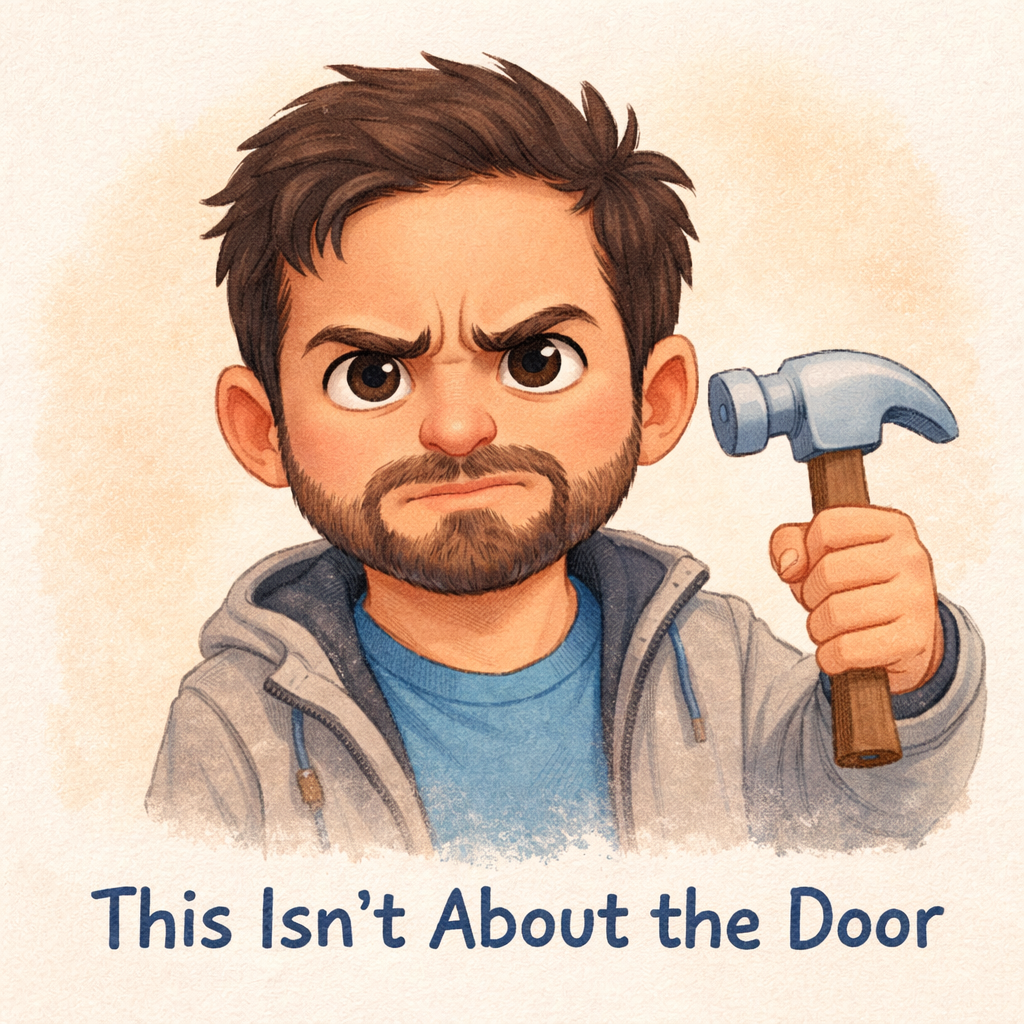
It’s not the door…
The other day I couldn’t do a very basic handyman task.
Nothing dramatic. A door. A bracket. A nail.
Something that, in my head, should have been easy.
Instead, I lost it.
I was smashing the door with a hammer.
I was yelling.
I was furious — not just annoyed, but that hot, tunnel-vision kind of rage where everything else disappears.
And at some point, I caught myself and thought:
This feels bigger than a door.
So I stopped.
And I asked myself why.
What surprised me wasn’t how quickly the answer came — it was what the answer was.
I realized I wasn’t really mad at the door.
I was mad at my dad.
Mad that he didn’t teach me how to do this.
Mad that he wasn’t there.
Mad that I still feel that absence in moments where it “shouldn’t” matter anymore.
That part stopped me cold.
On paper, this grief doesn’t make sense.
I’m an adult.
I’m capable.
I’ve built a good life.
And yet — there it was.
Why We Need Permission to Mourn the “Old Stuff”
We don’t often give ourselves permission to mourn things that feel outdated or socially awkward to grieve.
We’re supposed to be past them.
We’re supposed to have moved on.
But grief doesn’t care about timelines or logic.
Sometimes it hides in a doorframe.
Sometimes it comes out sideways as rage.
Sometimes it waits until you feel small, stuck, incompetent —
and then it shows up loud.
What I’ve learned (and keep relearning) is that anger is often a messenger.
It’s pointing to something that never got space.
Something that never got named.
When we don’t allow ourselves to mourn what should have been —
a parent who showed up, a skill we wish we had learned,
a version of ourselves that felt supported —
it leaks out anyway.
Usually at the worst possible time.
The Science (Why This Happens)
When we suddenly feel overwhelmed or incompetent, the brain often drops out of logical, problem-solving mode and into threat mode.
Our emotional brain takes over before we’ve had time to think.
Our brains are also incredible at association.
They link now with then.
A stuck screw isn’t just a stuck screw —
it taps into earlier experiences of feeling unsupported, alone, or expected to “figure it out.”
Research on emotional regulation shows:
Emotions that aren’t processed don’t disappear —
they get stored.
And later, when something familiar pokes them,
they come back as anger, shame, or sudden intensity.
This is emotional displacement —
the feelings belong to one situation…
but they show up in another.
Which means:
You’re not overreacting.
You’re reacting to something that never got acknowledged.
This Isn’t About Blame
This isn’t about rewriting the past or blaming parents.
It’s about honesty.
It’s about saying:
Yes — this still hurts.
Yes — this mattered.
Yes — I’m allowed to feel this… even now.
The door eventually got fixed.
The rage passed.
But the grief —
that needed a moment.
Maybe the permission we really need
is simply to notice it
when it shows up…
even if it shows up holding a hammer.
Homework (Gentle. Optional. Real-Life.)
If this resonates, here are small invitations — not fixes.
1️⃣ Name the “This Isn’t About the Door” Moment
Next time you feel a big reaction to a small problem, pause and ask:
What else might this be about?
You don’t need an answer.
Just ask.
2️⃣ Finish the Sentence
Say or write:
“I’m really upset about ___, but I think part of this is about ___.”
No judging. No editing.
3️⃣ A 60-Second Grief Window
Give the feeling one minute.
No solutions.
Just acknowledgment.
Grief often softens once it’s witnessed.
4️⃣ Remind Yourself
Say (out loud if you can):
“It makes sense that this showed up.”
Because most of the time —
it does.
Final Line
Sometimes mourning what should have been
is the most honest form of healing.
And sometimes…
that’s enough for now.
A Season of Fewer Tabs
A Season of Fewer Tabs
I’m bad at this.
Let’s just start there.
I am not naturally good at slowing down, doing less, or deciding that something is finished. My brain is always quietly… and loudly… asking:
“Okay… but what’s next?”
Even when things are good.
Especially when things are good.
And honestly? I see the same thing happening in schools all the time.
More programs.
More data.
More emails.
More interventions.
More enrichment.
More clubs.
More reminders to “just push through a little longer.”
Somewhere along the way, “doing enough” stopped feeling like enough.
The Tab Problem
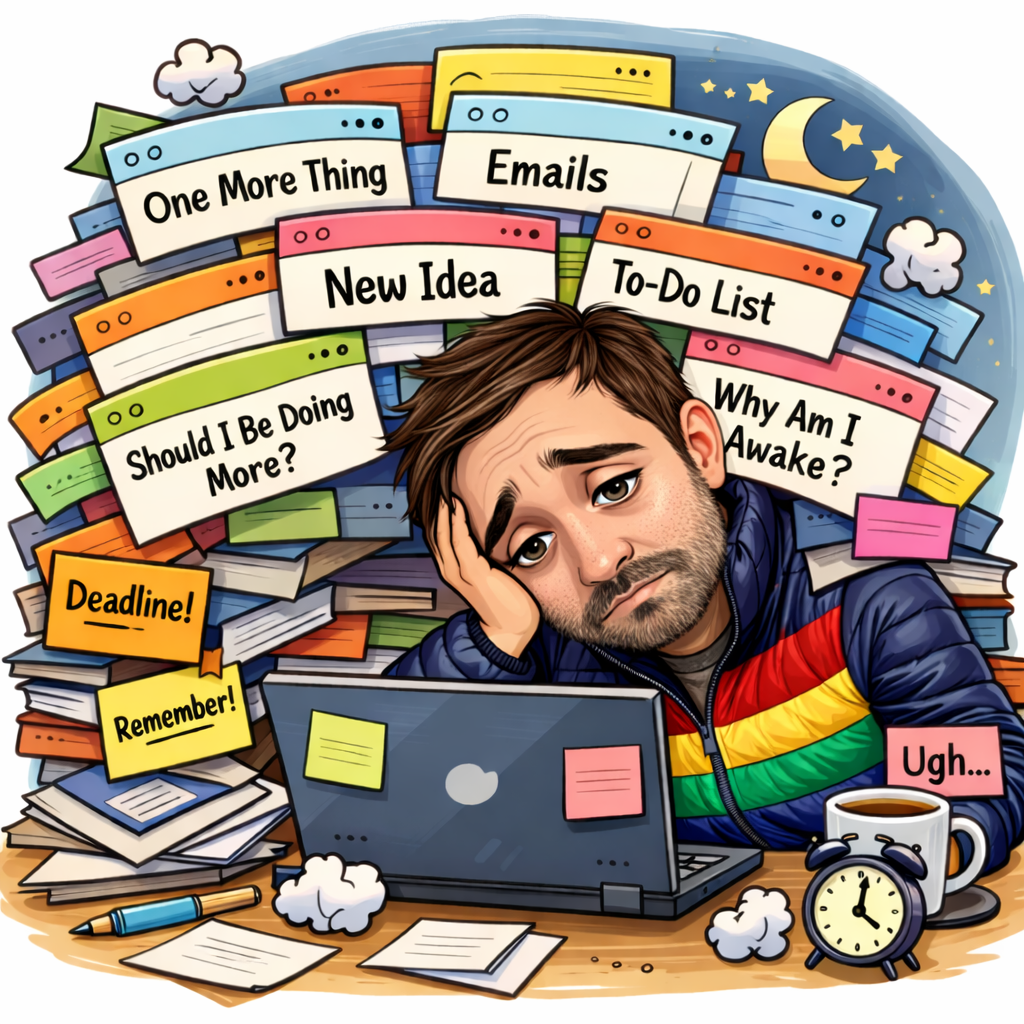
Recently I realized my brain feels like my laptop when I have too many tabs open.
Nothing is technically broken —
but everything is slower.
A little glitchy.
Slightly overheating.
Constantly humming in the background.
That’s what happens when we keep adding… without ever closing.
And here’s the part I don’t love admitting:
I often confuse being busy with being responsible.
If I’m doing more → I must be trying hard.
If I’m tired → it must mean I care.
If I can’t sleep → it’s probably because I haven’t figured it all out yet.
Spoiler: that’s not how sleep works.
What This Does to Sleep
When we don’t give ourselves permission to stop,
our brain never gets the signal that it’s safe to power down.
So at night, instead of rest, we get:
Mental replay
To-do list reruns
Conversations that already happened
Conversations that might happen
A strong urge to solve everything at 11:47 PM
It’s not because we’re bad at sleeping.
It’s because our nervous system still thinks we’re… on.
The Science (Friendly Version)
There’s a reason we stay busy — and it’s not because we love exhaustion.
From a psychological lens:
Being busy gives us predictability
Productivity provides short-term relief
Constant motion keeps us from sitting with discomfort
Our brains are wired to avoid uncertainty.
Stillness removes distraction — which means we suddenly hear the thoughts we’ve been dodging:
Am I doing enough?
What if I disappoint someone?
What if I stop and realize I’m overwhelmed?
What if… I don’t like how this feels?
Busyness becomes a coping strategy —
a socially approved one.
And in schools, this shows up as:
Over-programming
Overscheduling
Adults modeling exhaustion as commitment
Kids learning early that rest is something you earn, not something you need
When Enough Is… Enough
The hard question is never:
“What else should we add?”
The harder one is:
“What could we stop doing and still be okay?”
Or even scarier:
“What if we stopped… and nothing bad happened?”
A season of fewer tabs doesn’t mean giving up.
It means choosing intentionally.
Capacity is not unlimited — for adults or kids.
Sometimes the healthiest move
is closing something gently and saying:
“This is enough for now.”
Homework (Gentle, I Promise)
1️⃣ The Tab Audit
Write down 5 things currently taking up mental space.
Ask:
• Does this still matter?
• Is this mine to carry?
• Could this wait?
Close one tab. Just one.
2️⃣ The “Enough” Sentence
Once a day, finish:
“Today, enough looked like ______.”
No fixing.
No improving.
Just noticing.
3️⃣ The Nighttime Test
If sleep has been hard, ask:
“What am I afraid will happen if I stop thinking about this tonight?”
You don’t have to answer it.
Simply naming it is powerful.
🤍 Final Thought
I don’t have this figured out.
I’m practicing it alongside everyone else.
But I’m learning that:
Rest isn’t laziness
Slowing down isn’t quitting
And fewer tabs doesn’t mean fewer things matter
Sometimes it just means
we’re finally giving our brain — and our body —
permission to breathe.
And honestly?
That feels like enough for now.

Instead of a New Year’s Resolution, I’m Choosing a Direction
Every January, there’s a pressure to reinvent yourself.
New habits.
New routines.
A cleaner, calmer, more “together” version of you.
And look — I like growth. I like reflection. I really like a good fresh-start feeling.
But I’ve learned something about myself:
The moment my goals start sounding like rules,
I stop enjoying them.
And when I stop enjoying them?
I either rebel… or burn out.
So this year, I’m not doing strict resolutions.
I’m choosing a direction.
Not a checklist.
Not a streak.
Just a general way I want my life to lean.
The Direction I’m Aiming For
This year, I want to move toward what feels good — not in a reckless way, but in a listening way.
That looks like:
More time with people who make me feel like myself.
The ones I don’t perform for.
The ones I laugh easier around.
The ones I leave feeling grounded instead of drained.
Eating healthier — without turning food into a morality test.
More meals that actually fuel me.
More awareness of how food makes me feel.
And also…
yes — getting the milkshake sometimes.
Because joy is not a dietary failure.
Being on my phone less.
Not because phones are evil —
but because I don’t want my life to be something I scroll past.
I want more moments I’m in,
not just documenting
or distracting myself from.
None of these are rules.
They’re nudges.
Why Direction Works Better Than Resolutions
Resolutions tend to ask:
“Did you do it perfectly?”
Direction asks:
“Are you generally heading the way you want to go?”
If I eat well most days but get ice cream with a friend —
that still counts.
If I catch myself scrolling and put the phone down —
that counts.
If I choose connection over productivity once in a while —
that really counts.
A direction leaves room for being human.
How This Shows Up in Real Life
I’m not aiming for a perfectly balanced year.
I’m aiming for a year where I notice how I feel more often.
Where I ask myself:
“Do I want to be doing this right now?”
“Who do I want to share this with?”
“Is this helping — or just filling space?”
Sometimes the answer will be:
This is good.
Sometimes:
This can wait.
And sometimes:
Yes. Absolutely. Get the milkshake.
A Small Invitation (No Pressure)
If you want to try this instead of resolutions, ask yourself:
“What do I want more of this year — and what do I want a little less of?”
Not forever.
Not perfectly.
Just… more and less.
You can write it down.
Or don’t.
You’re allowed to adjust as you go.
Final Line
I’m heading into this year aiming for good people, decent food, fewer scrolls, and a little more ease.
No big promises.
Just a direction.
See you next week.