
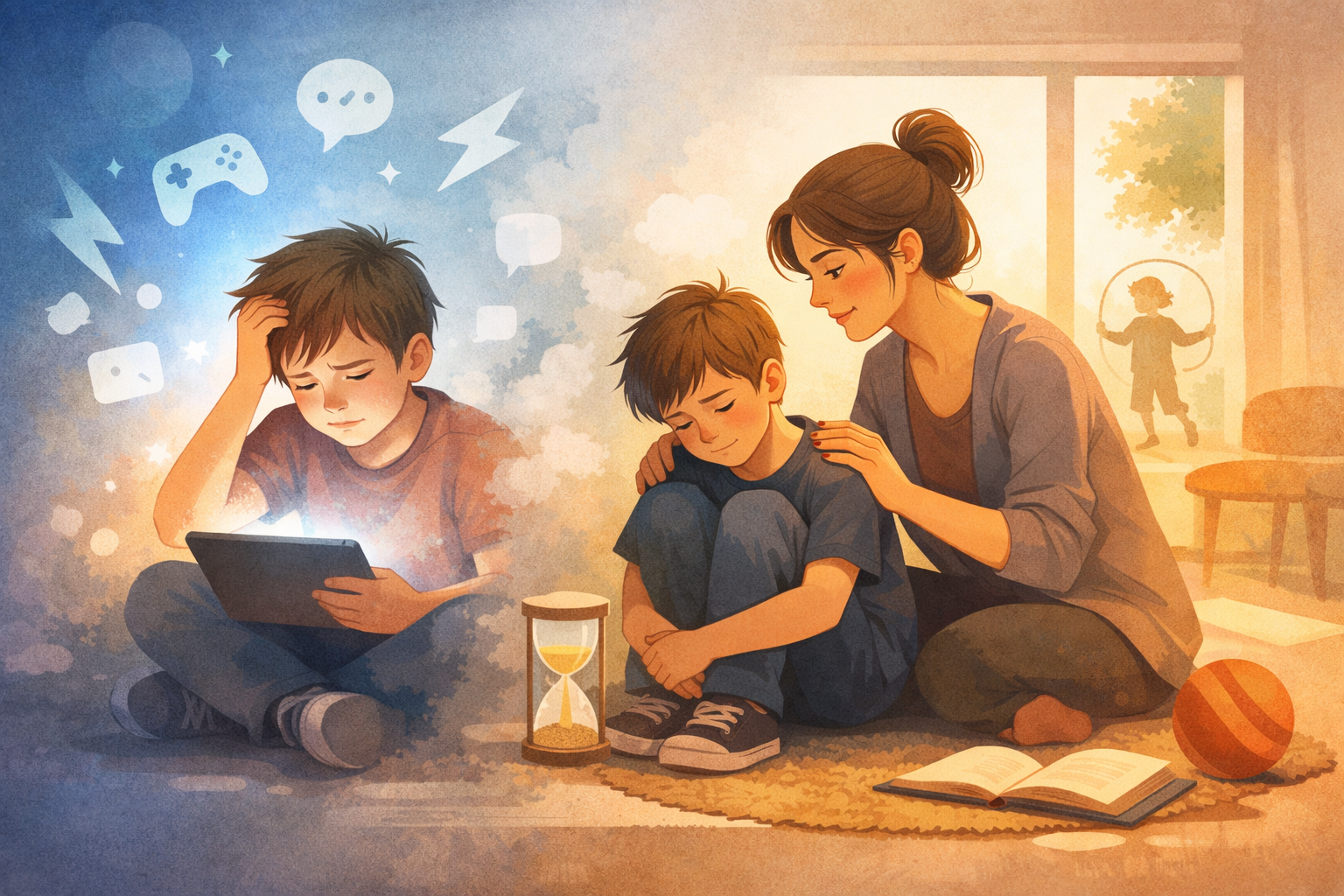
Why Emotional Regulation Is Harder After Screens
Hello, World!
If you’ve ever noticed that your child is more irritable, impulsive, tearful, or explosive after screen time, you’re not imagining it, and you’re not failing as a parent.
This is one of the most common patterns I see as a school psychologist.
It’s also one of the most misunderstood.
Let’s talk about why emotional regulation is harder after screens, and, more importantly, what actually helps.
What’s Really Happening in the Brain
Screens aren’t inherently bad. They’re engaging, stimulating, and often genuinely enjoyable.
The issue isn’t morality.
It’s nervous system load.
Most screen-based activities:
Provide rapid rewards
Require very little effort
Offer constant novelty
Bypass frustration and waiting
For a developing brain, especially one still building executive functioning skills, this creates high stimulation with very low regulation demand.
When the screen turns off, the brain doesn’t gently shift gears.
It slams on the brakes.
That’s when you might see:
Explosive reactions to small problems
Difficulty transitioning
Increased defiance or emotional outbursts
“Zombie-like” behavior followed by dysregulation
This isn’t manipulation.
It’s withdrawal from stimulation.
Why Some Kids Struggle More Than Others
Not all children respond to screens the same way
Kids who tend to struggle more after screens often have:
ADHD or executive functioning challenges
Anxiety (especially fear of getting in trouble or doing things “wrong”)
Sensory sensitivities
A nervous system that already runs “hot”
For these kids, screens don’t just entertain—they temporarily regulate.
When that regulation disappears, their internal system doesn’t yet know how to recalibrate on its own.
The Biggest Myth: “They Just Need Less Screens”
Reducing screen time can help, but it’s rarely the full solution.
I often see families remove screens entirely, only to find that:
Meltdowns still happen
Emotional regulation doesn’t magically improve
Everyone feels more exhausted
Why?
Because regulation is a skill, not an on/off switch.
If screens are the only thing helping a child regulate, removing them without teaching replacement strategies just leaves a gap.
What Actually Helps
1. Build a Transition Buffer
Don’t go straight from screen → expectation.
Try:
A 5–10 minute warning
A predictable routine (“screens off → snack → movement”)
A visual timer or countdown
Transitions are regulation opportunities, not inconveniences.
2. Add Movement Before Demands
Movement helps the nervous system reset.
This doesn’t need to be fancy:
Jumping jacks
A short walk
Carrying something heavy
Climbing, stretching, or roughhousing
Think body first, behavior second.
3. Lower Expectations Temporarily
Right after screens is not the time for:
Homework battles
Big conversations
High-level problem solving
This isn’t “giving in.”
It’s understanding that timing matters.
4. Narrate, Don’t Lecture
Instead of:
“You need to calm down.”
Try:
“Your brain is still coming down from screen mode. Let’s help it reset.”
This builds awareness without shame.
5. Teach Regulation Outside the Moment
Skills don’t stick during meltdowns.
Practice regulation when your child is calm:
Naming feelings
Noticing body cues
Trying calming strategies before they’re needed
Meltdowns are not teaching moments.
They’re support moments.
A Reframe That Helps Parents
If screen time is followed by dysregulation, the takeaway isn’t:
“Screens are ruining my child.”
It’s:
“My child needs more help transitioning and regulating.”
That’s a solvable problem.
And it gets better with understanding—not punishment.
Final Thought
Screens aren’t the enemy.
They’re powerful tools, and powerful tools require support.
When we shift from controlling behavior to supporting nervous systems, kids don’t just behave better.
They feel better.
And honestly?
So do parents.