Asking for Help is OK!
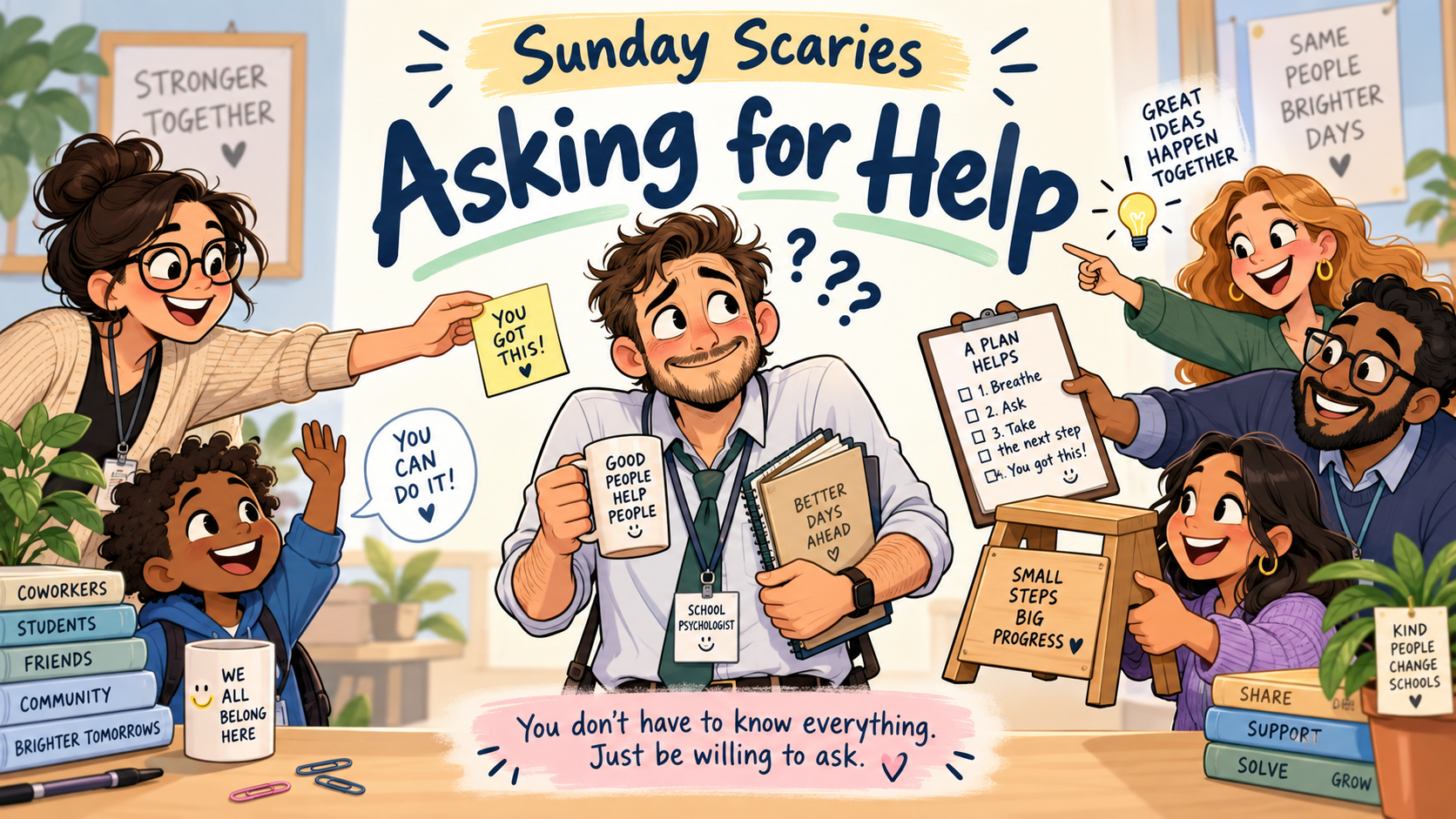
I work with a lot of different people, kids, adults, interns, coworkers, students—and one thing I’ve noticed is that we are all pretty good at pretending we know what we’re doing.
There’s something difficult about admitting that we don’t know something. Maybe we’re embarrassed. Maybe we think people will see us as less capable or less intelligent. Maybe we’ve convinced ourselves that we should be able to figure it out on our own. So instead of asking for help, we struggle, make mistakes, waste a bunch of time, and occasionally make things way harder than they ever needed to be.
I learned this lesson while trying to fix something electrical at my house. I didn’t really know what I was doing, but instead of calling someone who did, I kept messing with it. I tried things. I got frustrated. I made mistakes. I even shocked myself, which probably should have been a pretty strong indication that perhaps I was no longer qualified for the job.
Eventually, I called a friend and asked for help. She showed me what I was doing wrong, explained what I needed to do, and we figured it out in about five minutes. Five minutes! I had probably spent twenty times that long trying to fake my way through it because that was easier than saying, “Hey, I don’t know how to do this.”
The funny thing is, research suggests that asking for help is actually an important part of learning. When we ask someone to explain something, show us what we’re missing, or help us work through a problem, we aren’t avoiding learning—we’re doing it. We also tend to underestimate how willing other people are to help us. That person you’re worried about bothering might actually be perfectly happy that you asked.
Of course, asking for help doesn’t mean handing somebody your problem and saying, “You do it.” Sometimes it’s simply saying, “Can you show me?” or “I’m stuck here. What am I missing?” The goal isn’t to have someone else do the hard thing for you. It’s to learn enough that maybe next time, you can do a little more of it yourself.
And pretending we know what we’re doing can have real consequences. Sometimes we waste an hour. Sometimes we make a mistake at work or school. Sometimes we make a bad decision because we were too afraid to ask a question.
So maybe the better question isn’t, “Why don’t I know how to do this?” Maybe it’s, “Who can help me learn how to do this?” Not knowing something isn’t the problem. Staying stuck because we’re afraid to admit we don’t know is.
This week, if you’re confused, overwhelmed, stuck, or just have absolutely no idea what you’re doing, try saying it. Ask the question. Call the friend. Raise your hand. Because asking for help isn’t proof that you aren’t capable. Sometimes it’s one of the smartest things you can do.
You don’t have to know everything. You just have to be willing to ask.

What makes a friend?
A kid asked me recently how you make a friend, and then followed it up with an even better question… what even is a friend? I gave him an answer at the time, but I’ve thought about it a few times since because it’s actually a pretty good question. We spend our entire lives making friends, losing friends, finding new ones, and trying to keep up with old ones, but I’m not sure how often we stop and think about what actually makes someone a friend.
As an adult, I think about the people I consider my friends and a lot of it is pretty simple. We go out to eat, watch sports, go to movies or concerts, play music, or just do the things we both like doing. Sometimes we talk on the phone, although that feels like it happens WAY less than it used to. But ultimately, I think a friend is someone who is there for you. They’re there when something really cool happens and you can’t wait to tell someone, but they’re also there when things are hard and you need somebody in your corner.
I also think we learn as we get older that there are all kinds of friends. As a kid, there’s so much emphasis on having a “best friend,” like we’re all supposed to choose one person and hand them the trophy. But life doesn’t really work that way. There are work friends, school friends, sports friends, friends you tell everything to, and friends you mostly just have a really good time with. There are also friends who are only around for a season. Sometimes nobody did anything wrong and nobody had some giant falling out… life just changed. Someone can be really important during one part of your life and not be part of the next one, and that doesn’t make the friendship any less real.
So how do you actually make a friend? I think you just have to put yourself out there a little bit. Say hi. Sit next to somebody. Ask a question. Invite someone to do something. Sometimes it’s awkward, and sometimes the other person doesn’t choose you back. That part isn’t particularly fun whether you’re 10 or 37. But most friendships probably started because one person made a tiny effort and the other person made one back.
Keeping friends might actually be harder. Life gets busy, especially as adults, and it’s easy to assume the people we care about know we care about them. Send the text anyway. Make the plan. Remember the thing they told you about. Celebrate the good stuff with them and show up for the hard stuff. Friendship doesn’t have to mean talking every day, but I do think it means continuing to make space for each other.
Maybe that’s the answer I should have given the kid. A friend is someone you enjoy being around, but it’s also someone who makes you feel like there’s a place for you in their life. You make a little effort, they make a little effort back, and over time you keep choosing each other.
Actually… maybe that’s pretty good advice for the adults too.
The Sunday Scaries: Maybe Take the Chance
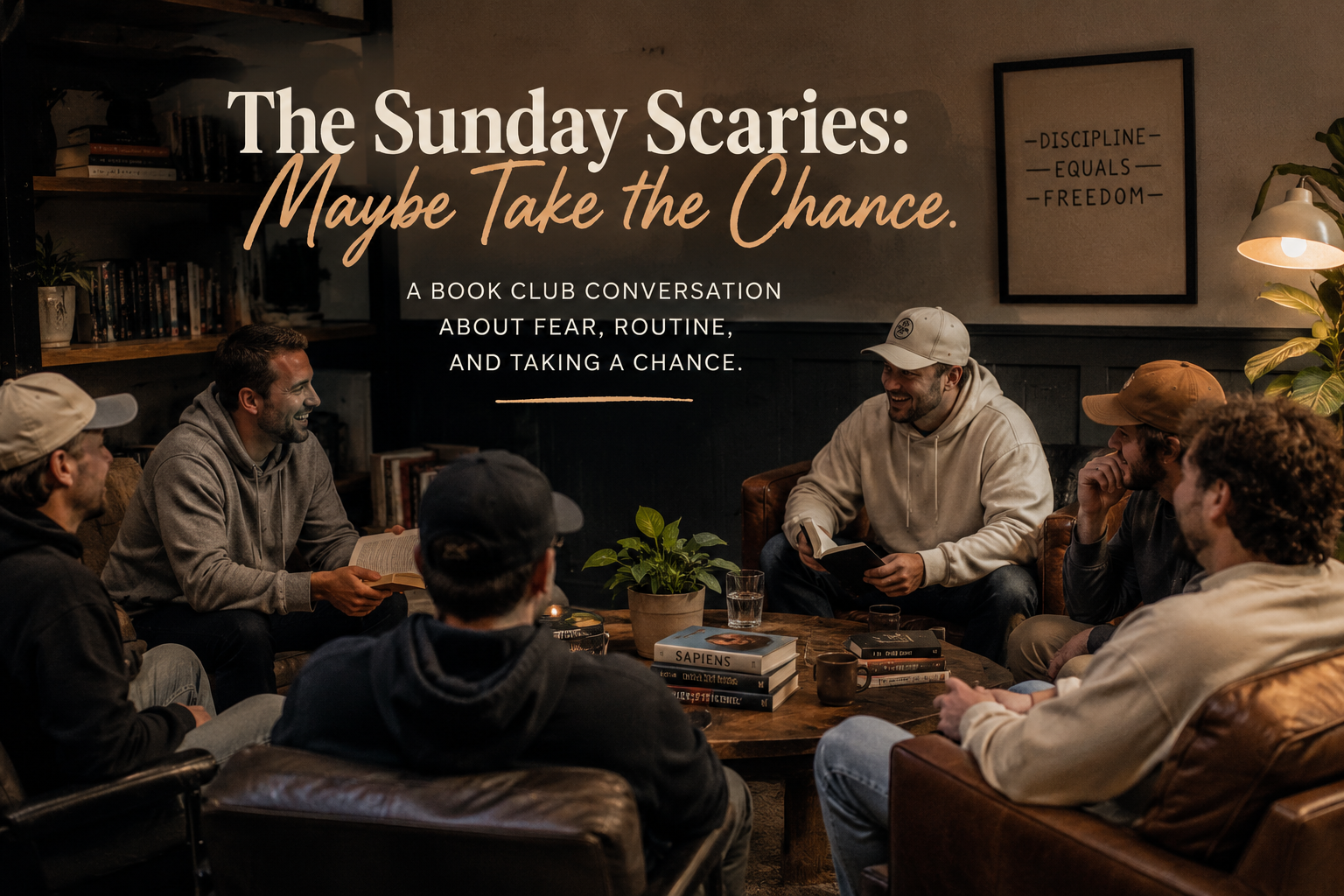
I started going to a book club this month.
Which, honestly, is probably a small example of what I want to talk about this week. Going somewhere new, sitting in a room with people I didn’t really know, and then somehow ending up in a conversation about some of our deepest fears.
You know, casual book club stuff.
We talked about letting people down, looking stupid, failing, not being open enough, putting yourself out there and having it not work out. And as I sat there listening, I kept hearing a common theme underneath a lot of it: taking a chance is freaking hard.
Because the alternative is really, really comfortable.
There is a reason we stay in our comfort zones. They work. We know what happens there. We know the routine, we know the people, and we know what we are good at. Maybe more importantly, we know how to avoid the things we aren't good at. It’s the path of least resistance, and honestly, there is something pretty nice about that.
And I don't even think comfort is necessarily a bad thing. Routine can be good. I love a routine. There is something great about knowing what your day looks like and feeling like you have some control over it. But I think the problem comes when comfortable quietly turns into stuck, and we don't even really notice it happening.
Sitting in that room of strangers talking about fear, I started thinking about what it actually means to face one. I think sometimes we picture facing a fear as this giant, dramatic moment where we suddenly decide we aren't scared anymore. Quit the job. Get on the plane. Tell the person how you feel. Sign up for the thing. Jump straight into the deep end and hope you figure out how to swim.
But maybe it doesn't have to work like that.
Maybe facing something you're afraid of is a lot more boring than that. Maybe you just put your feet in the water for a while. Then next time you go a little deeper. You don't have to cannonball into the damn pool just because you finally decided you wanted to get in.
I think that's where taking chances can feel a little more manageable. It doesn't have to mean blowing up your entire life or becoming some wildly adventurous new version of yourself overnight. It might just mean sending an email you've been thinking about, going somewhere by yourself, trying something you've always wondered about, saying yes when your first instinct is to come up with an excuse, or finally having a conversation you've been avoiding.
And sure, some of those things might not work out. You might look a little silly. Someone might say no. You might try something new and discover that you absolutely freaking hate it. But that's also kind of the deal, right? If we want the possibility of something new happening, we have to accept at least a little bit of the possibility that it doesn't go the way we hoped.
The funny thing is, I don't think most of us need to completely reinvent our lives. We probably just need to get a little more comfortable being uncomfortable every once in a while. Because every time we do something that scares us a little bit and survive it—which, spoiler alert, we usually do—the scary thing gets just a tiny bit smaller.
So that's the homework this week. Think about something you've been avoiding, putting off, or talking yourself out of simply because it feels uncomfortable. You don't have to conquer it this week, and you definitely don't need to jump into the deep end. Just ask yourself what putting your feet in the water would look like.
Maybe it's sending the text. Maybe it's showing up somewhere new. Maybe it's asking the question, signing up for something, or finally telling somebody what you've been thinking. Whatever it is, make it small enough that you can actually do it.
Because your comfort zone isn't the enemy. It's comfortable for a reason, and sometimes it's a pretty great place to be. I just don't know if we're supposed to spend all of our time there.
So this week, maybe wander a few steps outside of it and see what happens.
You can always come back.
But you might find something out there worth staying for.
Why We Feel Like Giving Up…And what that feeling is actually trying to tell us
Everyone reaches a moment where they want to quit.
A project.
A relationship.
A goal.
A plan that once felt exciting but now just feels heavy.
Sometimes the thought shows up quietly.
What’s the point?
Other times it’s louder.
Maybe I should just give up.
Most people assume that feeling means something has gone wrong.
But often it means something else.
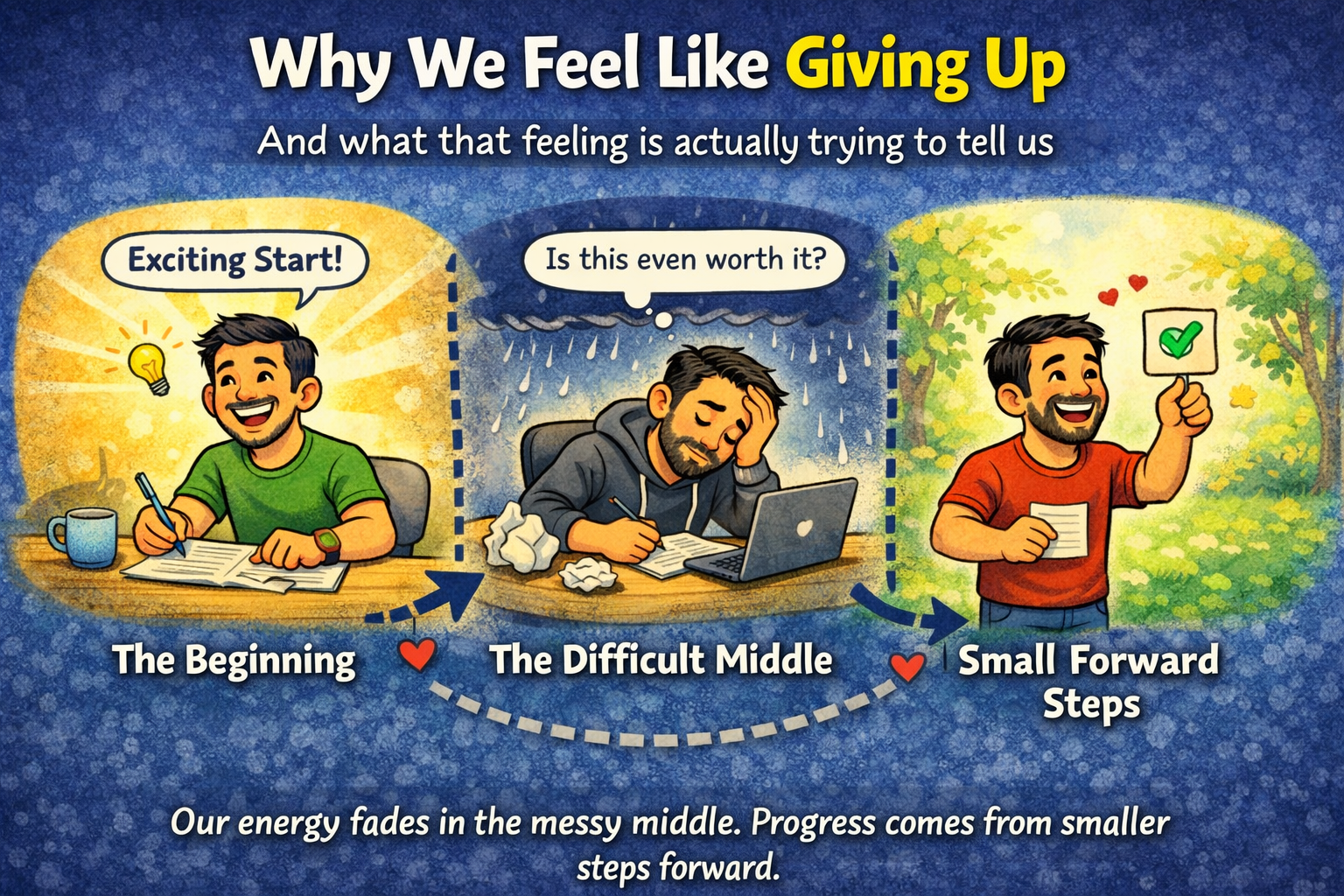
It means you’ve reached the middle.
And the middle is where motivation almost always disappears.
The beginning is fueled by hope
When we start something new, our brain is full of energy.
We imagine the outcome.
The new job.
The healthier routine.
The stronger relationship.
The finished project.
Hope carries us through the beginning.
The middle is fueled by friction
Then reality arrives.
Things take longer than expected.
Progress feels slow.
Effort starts to outweigh excitement.
This is the point where people start wondering if they should quit.
But the feeling of wanting to give up isn’t always a sign you’re failing.
Often it’s just a sign that the easy energy has run out.
Now the work becomes something different.
Not excitement.
Commitment.
Why the feeling gets so strong
Our brains are built to conserve energy.
When something becomes difficult, the brain starts asking questions like:
Is this worth it?
Is there an easier option?
Would stopping feel better?
Those thoughts aren’t weakness.
They’re just the brain doing its job.
The problem is that the brain is very good at detecting discomfort, but not very good at predicting long-term reward.
So when the middle gets hard, the brain starts trying to escape.
The question that helps
When the urge to quit shows up, most people ask the wrong question.
They ask:
“Should I give up?”
But that question usually leads to panic thinking.
A better question is:
“What kind of tired am I?”
Sometimes we are:
• physically tired and need rest
• emotionally tired and need support
• mentally tired and need a break
But sometimes we’re just experiencing the normal discomfort of doing something that matters.
Learning the difference is important.
Because quitting something that matters often creates a different kind of pain later.
Regret.
What actually helps in those moments
When people push through the “giving up” phase, they rarely do it through sheer motivation.
Instead they do something much simpler.
They make the next step smaller.
Instead of finishing the project…
Work on it for 20 minutes.
Instead of fixing the whole relationship…
Start one honest conversation.
Instead of changing everything…
Change one small habit today.
Momentum doesn’t return through huge effort.
It returns through tiny forward movement.
One quiet truth
Most meaningful things in life pass through a phase where quitting feels reasonable.
Friendships.
Careers.
Creative projects.
Personal growth.
The feeling of wanting to give up doesn’t mean you chose the wrong path.
Sometimes it just means you’ve reached the point where the path becomes real.
And that’s the part most people don’t talk about.
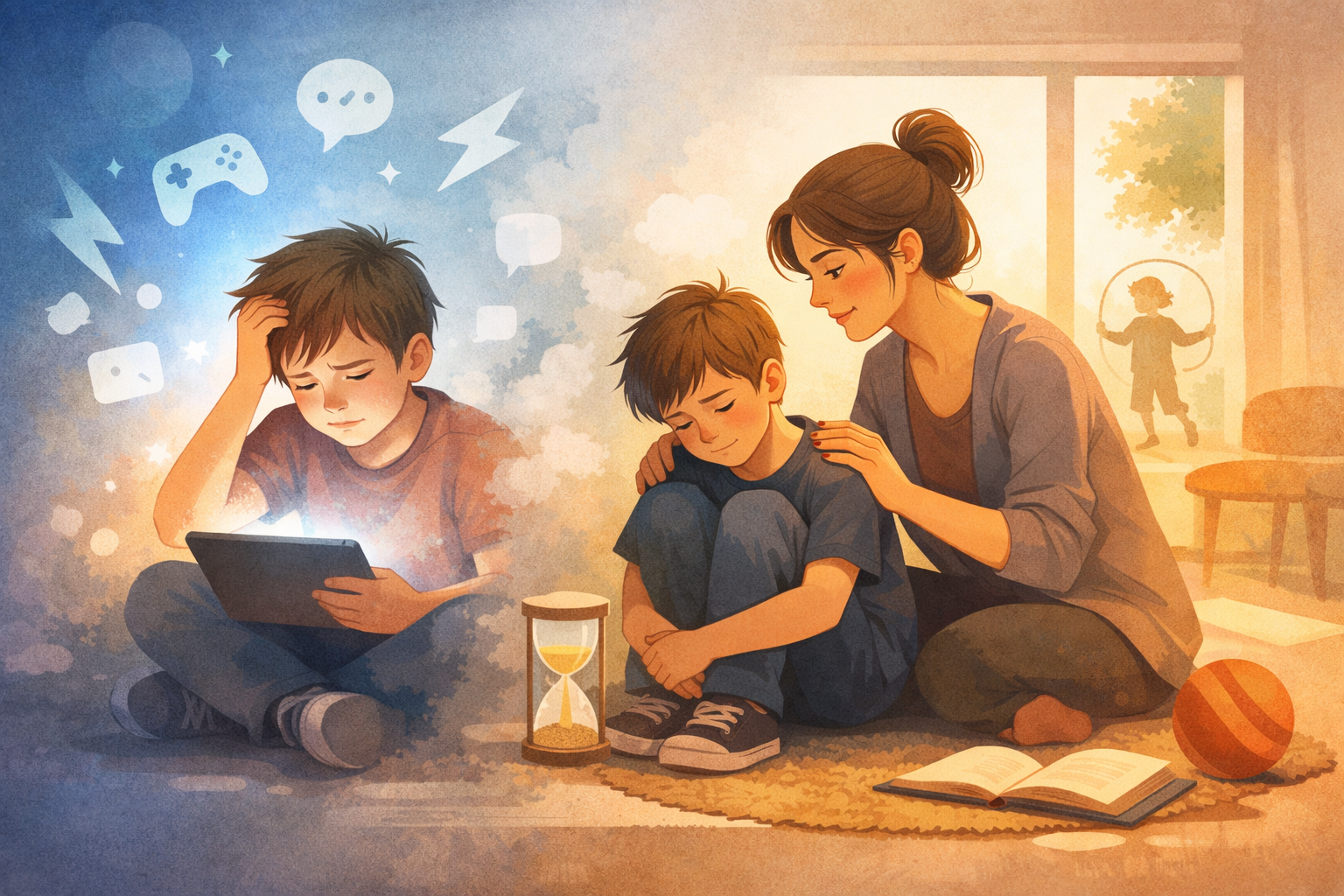
Why Emotional Regulation Is Harder After Screens
Hello, World!
If you’ve ever noticed that your child is more irritable, impulsive, tearful, or explosive after screen time, you’re not imagining it, and you’re not failing as a parent.
This is one of the most common patterns I see as a school psychologist.
It’s also one of the most misunderstood.
Let’s talk about why emotional regulation is harder after screens, and, more importantly, what actually helps.
What’s Really Happening in the Brain
Screens aren’t inherently bad. They’re engaging, stimulating, and often genuinely enjoyable.
The issue isn’t morality.
It’s nervous system load.
Most screen-based activities:
Provide rapid rewards
Require very little effort
Offer constant novelty
Bypass frustration and waiting
For a developing brain, especially one still building executive functioning skills, this creates high stimulation with very low regulation demand.
When the screen turns off, the brain doesn’t gently shift gears.
It slams on the brakes.
That’s when you might see:
Explosive reactions to small problems
Difficulty transitioning
Increased defiance or emotional outbursts
“Zombie-like” behavior followed by dysregulation
This isn’t manipulation.
It’s withdrawal from stimulation.
Why Some Kids Struggle More Than Others
Not all children respond to screens the same way
Kids who tend to struggle more after screens often have:
ADHD or executive functioning challenges
Anxiety (especially fear of getting in trouble or doing things “wrong”)
Sensory sensitivities
A nervous system that already runs “hot”
For these kids, screens don’t just entertain—they temporarily regulate.
When that regulation disappears, their internal system doesn’t yet know how to recalibrate on its own.
The Biggest Myth: “They Just Need Less Screens”
Reducing screen time can help, but it’s rarely the full solution.
I often see families remove screens entirely, only to find that:
Meltdowns still happen
Emotional regulation doesn’t magically improve
Everyone feels more exhausted
Why?
Because regulation is a skill, not an on/off switch.
If screens are the only thing helping a child regulate, removing them without teaching replacement strategies just leaves a gap.
What Actually Helps
1. Build a Transition Buffer
Don’t go straight from screen → expectation.
Try:
A 5–10 minute warning
A predictable routine (“screens off → snack → movement”)
A visual timer or countdown
Transitions are regulation opportunities, not inconveniences.
2. Add Movement Before Demands
Movement helps the nervous system reset.
This doesn’t need to be fancy:
Jumping jacks
A short walk
Carrying something heavy
Climbing, stretching, or roughhousing
Think body first, behavior second.
3. Lower Expectations Temporarily
Right after screens is not the time for:
Homework battles
Big conversations
High-level problem solving
This isn’t “giving in.”
It’s understanding that timing matters.
4. Narrate, Don’t Lecture
Instead of:
“You need to calm down.”
Try:
“Your brain is still coming down from screen mode. Let’s help it reset.”
This builds awareness without shame.
5. Teach Regulation Outside the Moment
Skills don’t stick during meltdowns.
Practice regulation when your child is calm:
Naming feelings
Noticing body cues
Trying calming strategies before they’re needed
Meltdowns are not teaching moments.
They’re support moments.
A Reframe That Helps Parents
If screen time is followed by dysregulation, the takeaway isn’t:
“Screens are ruining my child.”
It’s:
“My child needs more help transitioning and regulating.”
That’s a solvable problem.
And it gets better with understanding—not punishment.
Final Thought
Screens aren’t the enemy.
They’re powerful tools, and powerful tools require support.
When we shift from controlling behavior to supporting nervous systems, kids don’t just behave better.
They feel better.
And honestly?
So do parents.
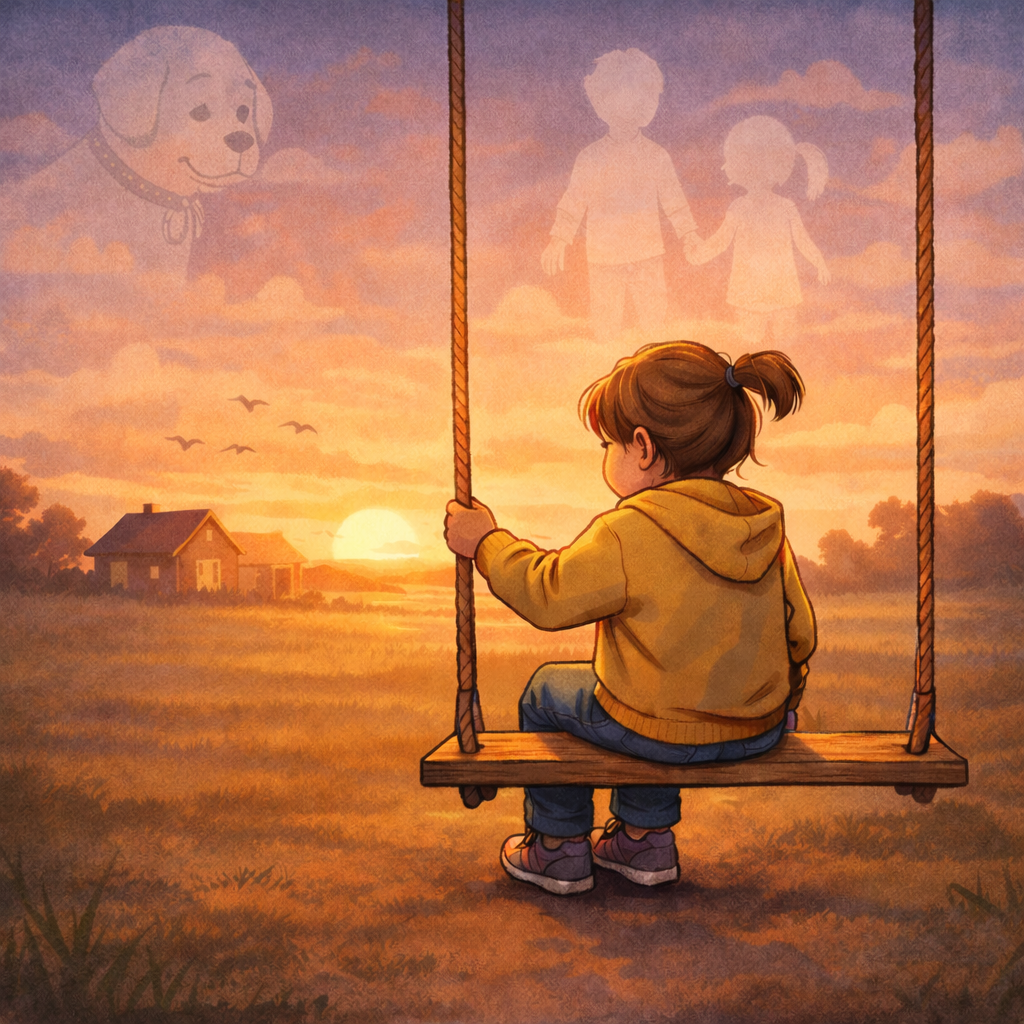
When Something You Love Goes Away
Sometimes, something really important goes away.
It might be a person you love.
A pet.
A teacher.
A friend.
A home.
A routine.
Even a version of life that felt safe.
And when that happens, it can feel confusing, heavy, or unfair—especially for kids, who don’t always have the words yet.
Here’s something important to know first:
If you feel sad, mad, quiet, weird, or nothing at all—you’re not doing it wrong.
Loss doesn’t come with instructions.
Loss Can Look Like a Lot of Things
Grown-ups sometimes think “loss” only means when someone passes away. But kids lose things in lots of ways:
A best friend who moves away
A pet that doesn’t come home
Parents who separate
A favorite teacher changing schools
A grandparent who gets very sick
A life that suddenly feels different
Your brain notices when something meaningful disappears.
Your heart notices too.
Feelings Don’t Follow Rules
Some days you might cry.
Some days you might laugh and feel fine.
Some days you might feel mad at everyone.
Some days you might not feel much at all.
All of that is allowed.
Feelings don’t line up neatly. They show up when they want to.
Missing Means It Mattered
Here’s a gentle truth I tell kids all the time:
If it hurts to miss someone or something, that means it was important.
The pain isn’t proof that you’re weak.
It’s proof that you cared.
And caring is a good thing, even when it hurts.
You Don’t Have to “Be Over It”
Sometimes people say things like:
“You’re so strong.”
“At least you still have…”
“It’s time to move on.”
But healing doesn’t mean forgetting.
It doesn’t mean pretending nothing happened.
It means learning how to carry the memory without it hurting quite as much.
That takes time. And time looks different for everyone.
A Small Thing That Can Help
If you’re a kid (or helping one), try this:
Name it.
You can say:
“I miss ___.”
“I’m sad because ___.”
“I don’t like that this changed.”
Saying it out loud helps your brain and heart work together.
You’re Not Broken
If you’re hurting, nothing is wrong with you.
If you’re not hurting yet, nothing is wrong with you either.
Loss is part of being human.
And humans heal best when they’re allowed to feel, ask questions, and be honest.
One Last Thing
Even when something goes away,
what it gave you doesn’t disappear.
The love stays.
The memories stay.
The way it changed you stays.
And you don’t have to carry it alone.
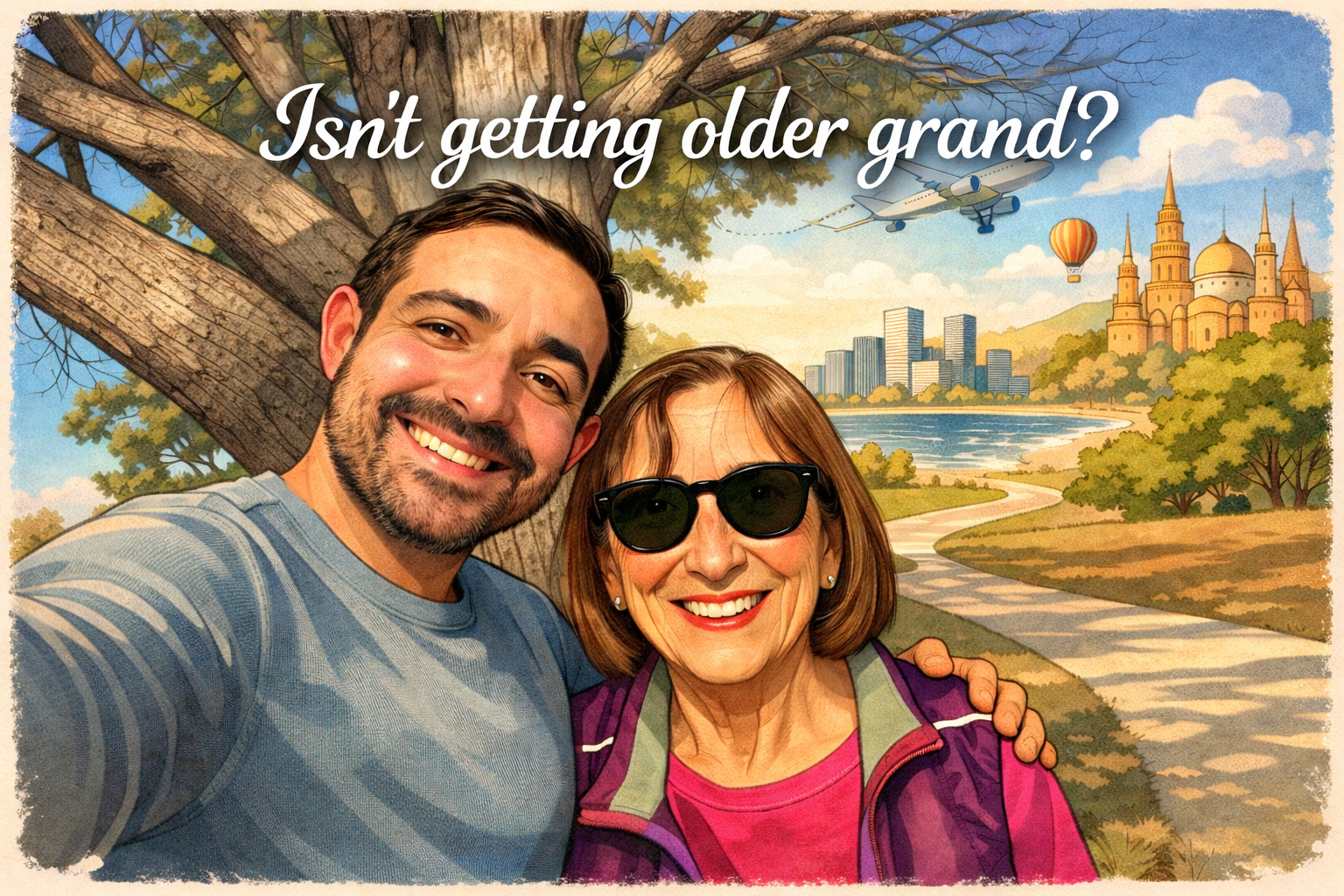
Isn’t getting older grand?
A child I work with recently told me they’re scared to get older.
They talked about bigger expectations. More responsibility. Harder days.
They worried that something important might disappear—that being older would mean less fun, less safety, less magic.
It wasn’t dramatic. It was honest.
And sitting there with them, I realized how often we talk about getting older like it’s something to brace for instead of something to step into.
We warn kids about it.
We joke about it as adults.
We measure it in losses more than gains.
But the truth is, getting older isn’t just about what gets heavier.
It’s also about what gets wider.
What We’re Afraid Of When We Think About Getting Older
The fear makes sense.
Getting older does come with more responsibility.
More decisions.
More moments where no one swoops in to fix things for you.
For kids, that can feel like the end of something precious.
For adults, it can feel like a narrowing—fewer options, fewer chances, fewer firsts.
We don’t lie when we acknowledge that weight.
But we miss something important when we stop there.
What Actually Grows With Age
What we don’t talk about enough is how much capacity grows as we age.
You gain skills you couldn’t have accessed earlier:
Emotional regulation
Perspective
Knowing when to push and when to rest
Knowing what matters and what doesn’t deserve your energy
These skills don’t arrive all at once.
They stack quietly, year after year, often unnoticed until you need them.
You also gain new freedoms:
Choosing your people
Choosing your pace
Choosing how much you explain
Choosing what you no longer carry
Getting older doesn’t mean you lose agency.
It often means you finally get to use it.
Three Generations, One Moment
This all hit me in the same week I was talking with that child.
I’m getting another year older next week.
Not in a dramatic way—just one of those birthdays that sneaks up on you.
At the same time, I’m planning a summer trip with my 78-year-old mom.
We’re traveling to foreign countries together—new streets, new languages, unfamiliar places.
Watching her plan that trip is a quiet reminder of something powerful:
getting older doesn’t mean you stop exploring.
It often means you explore with more confidence, more curiosity, and fewer apologies.
In one week, I’m holding:
A child afraid of growing up
My own reflection on aging
And a parent who is still expanding her world
That doesn’t feel like decline.
It feels like continuity.
A Better Way to Think About “Older”
Getting older doesn’t mean the door closes.
It means the map gets bigger.
Each year adds tools you didn’t have before.
Each year gives you more choice about how you move through the world.
Yes, the stakes change.
Yes, responsibility increases.
But so does your ability to meet what’s in front of you.
What I Told the Child (and What I Tell Myself)
I didn’t tell my client not to be scared.
I told them that every year comes with new tools they don’t have yet—and that they won’t be alone when those years arrive.
And I think that’s the part worth holding onto.
The excitement of getting older isn’t loud.
It doesn’t announce itself.
It shows up quietly—in new skills, new freedoms, and the growing realization that you’re more capable than you once were.
That doesn’t mean life gets easier.
It means you get stronger at living it.
And honestly?
That’s something to look forward to.