

Who Cares? (In the Kindest Way Possible)
The other night after a show, a woman in the crowd shared something quietly and honestly.
She said she wished she could sing or dance in front of people—but she was too afraid of being judged.
Not “I can’t.”… “I’m scared.”
That stuck with me.
Because that fear isn’t really about singing or dancing. It’s about being seen. It’s about worrying what other people might think if we show a piece of ourselves that isn’t polished, practiced, or approved.
And it brought me back to a moment years ago when I was making art alongside a well-established artist. Her work was confident, effortless, clearly shaped by years of experience. Mine felt small in comparison.
I remember staring at my piece and thinking, Why am I even doing this?
I wanted to throw it away before anyone noticed it.
She looked at me, then at my work, and said something I’ve carried with me ever since:
“Art is for you.
This is how you see butterflies.
And that’s what matters.”
We weren’t making “good” butterflies.
We were making our butterflies.
And that’s when it clicked.
Who cares?
Not in a dismissive way.
Not in a “nothing matters” way.
But in a gentle way.
A way that says:
We’re all just working our way through life the best we can.
What “Who Cares” Really Means
When I say who cares, I don’t mean:
Stop trying
Be reckless
Nothing matters anyway
I mean:
You don’t have to carry imagined judgment
You don’t need universal approval
You’re allowed to exist imperfectly
Most of us aren’t afraid of failing.
We’re afraid of being evaluated while we try.
But here’s the truth we forget:
Everyone else is doing the same thing…figuring it out as they go, hiding their own doubts, hoping they’re “doing it right.”
Who cares if your art isn’t the best in the room?
Who cares if your voice shakes?
Who cares if your version looks different?
Not because it’s meaningless…but because it’s human.
The Science of Fear (and Why It Feels So Loud)
Fear isn’t a personal flaw. It’s biology.
Your brain’s alarm system—the amygdala—exists to keep you safe. The problem is that it reacts to social threat the same way it reacts to physical danger.
Judgment, embarrassment, rejection?
Your nervous system reads those as risk.
So when you think about:
singing
dancing
creating
sharing
Your body reacts before your logic catches up.
Fear says: “Don’t do this.”
Not because it’s dangerous,but because it’s unfamiliar.
And your brain would rather keep you comfortable than help you grow.
A Softer Way to Move Through Fear
Instead of trying to “beat” fear, try walking with it.
1. Shrink the moment
You don’t have to perform.
Create where no one else is watching.
Fear learns through experience,not pressure.
2. Name what you’re actually afraid of
Often it’s not the act itself.
It’s:
being judged
being compared
being misunderstood
Naming fear turns it from a monster into information.
3. Ask the real question
Not “Is this good?”
But “Is this mine?”
That’s where freedom lives.
4. Practice “who cares” on purpose
When the critical voice shows up, try responding with:
“Maybe. And I’ll be okay anyway.”
That’s not giving up.
That’s letting go.
The Homework (Low Pressure, High Permission)
This week, do one small thing just for you.
Sing.
Draw.
Dance.
Write.
Create.
No fixing. No sharing. No improving.
Afterward, ask yourself:
What was I worried would happen?
What actually happened?
Did the fear pass?
How did my body feel afterward?
Let the answer matter more than the outcome.
Because life isn’t about doing it perfectly.
It’s about doing it honestly.
And maybe the kindest thing we can remind ourselves is this:
Who cares?
We’re all just doing our best—
and that’s what’s important.
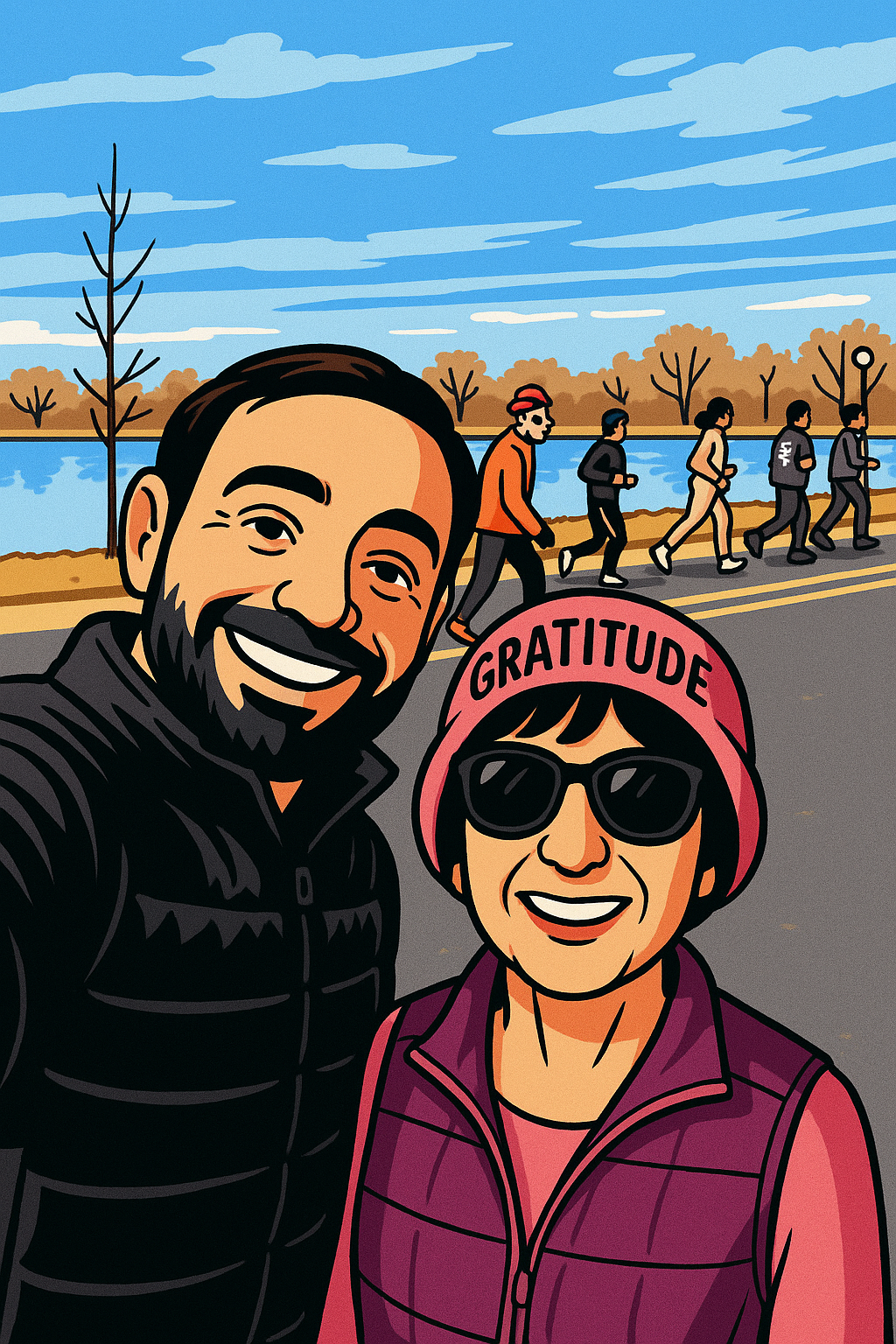
The Quiet Kind of Gratitude
Gratitude hits differently as you get older.
It stops being something you list in a journal or talk about around the holidays. It becomes quieter. Heavier. More honest. Something you feel humming in the background of your life without needing to announce it.
For me, gratitude almost always circles back to my mom.
She was never the type to point out her sacrifices or make her support about her. She just showed up. Over and over, in ways I didn’t fully understand until much later.
I think about being 13 years old, guitar case bigger than I was, playing tiny shows in restaurants and cafés where the “stage” was just a corner with one flickering bulb. Somehow, she drove me to every single one. Weeknights. Weekends. Snowstorms. Long days. She sat in the back, smiling even when I was shaky or unsure — like the music mattered simply because I cared about it.
I think about graduations, too, every milestone, every ceremony, every moment when the future felt both exciting and terrifying. She was there for all of it. Fully present. Fully steady.
And then there were the smaller things, the things that shouldn’t matter as much as they do, but somehow do anyway.
The dessert samplers she’d bring home when she could tell I needed something comforting.
The quiet moments when life felt heavy.
The subtle reminders that someone was rooting for me.
It wasn’t about the desserts.
It was the message behind them:
I see you. I’m with you. I’m not going anywhere.
The older I get, the more I appreciate that consistency.
Because she didn’t just show up when I was thriving.
She showed up when I wasn’t.
She supported the version of me that felt proud and confident, and the version that felt lost, overwhelmed, or unsure who I was supposed to be. So much of who I am today, how I care for people, how I show up for my students, how I handle setbacks, how I try to lead with compassion, it comes directly from her quiet, steady influence.
That’s the kind of gratitude that stays with you.
Not performative.
Not seasonal.
But lived.
The Science of Quiet Gratitude (and How to Practice It Daily)
One thing I’ve learned both personally and through my work is that gratitude doesn’t have to be loud to be powerful. In fact, research shows that the quietest forms of gratitude often do the most good.
Psychologists call this trait gratitude, the ability to consistently notice the good in your life, even in small doses. People who cultivate trait gratitude tend to have:
lower stress and anxiety
better emotional regulation
stronger, more trusting relationships
higher resilience during difficult seasons
And you don’t develop trait gratitude through a once-a-year reflection.
You build it the same way my mom showed up for me, through small, steady moments that add up over time.
Quiet gratitude looks like:
noticing the first warm sip of coffee (If you drink it, hot chocolate for those who like the good stuff)
taking a breath before walking into work and recognizing one thing that feels okay today
paying attention to someone’s softened tone when they speak to you
letting a moment of support actually sink in
remembering who has shown up for you without being asked
Research is clear on this:
You don’t have to feel overwhelmed with gratitude for it to count.
You just have to notice.
Noticing is the practice.
And the practice compounds.
A tiny moment today becomes a little more awareness tomorrow.
A little more grounding next week.
A little more emotional space when life gets chaotic.
For me, quiet gratitude shows up when I think about my mom in those passing moments — when I feel supported, or proud, or when I show up for someone else the way she showed up for me.
It’s not loud.
It’s not dramatic.
But it’s real.
And it changes the way I move through the world.
A Challenge for the Week
Think of the person who has shown up for you in every season — the one who cheered when you were thriving and stayed steady when you weren’t.
Reach out.
Tell them.
Say thank you.
Sometimes gratitude isn’t about grand gestures.
It’s about acknowledging the quiet, consistent love that shaped you — whether you realized it at the time or not.