
Permission to Mourn the Things We’re “Supposed” to Be Over
It’s not the door…
The other day I couldn’t do a very basic handyman task.
Nothing dramatic. A door. A bracket. A nail.
Something that, in my head, should have been easy.
Instead, I lost it.
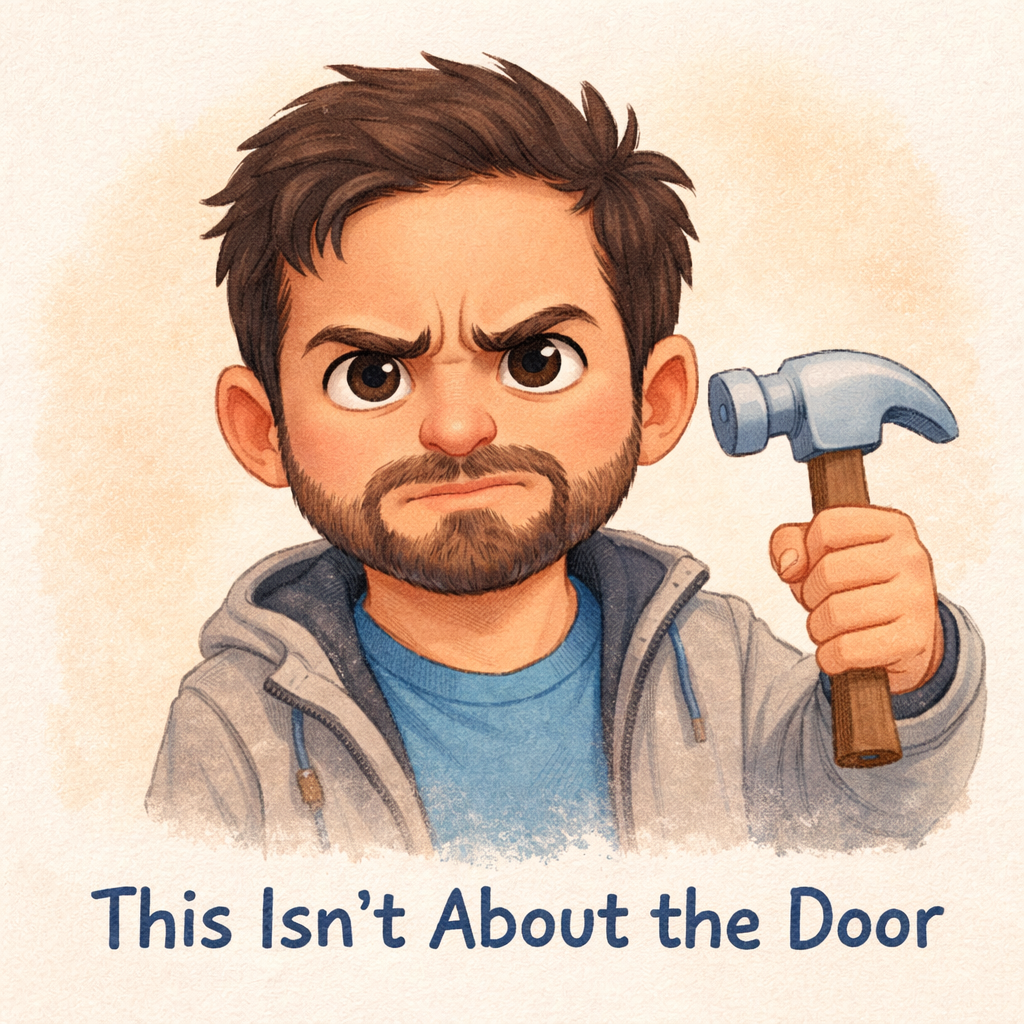
I was smashing the door with a hammer.
I was yelling.
I was furious — not just annoyed, but that hot, tunnel-vision kind of rage where everything else disappears.
And at some point, I caught myself and thought:
This feels bigger than a door.
So I stopped.
And I asked myself why.
What surprised me wasn’t how quickly the answer came — it was what the answer was.
I realized I wasn’t really mad at the door.
I was mad at my dad.
Mad that he didn’t teach me how to do this.
Mad that he wasn’t there.
Mad that I still feel that absence in moments where it “shouldn’t” matter anymore.
That part stopped me cold.
On paper, this grief doesn’t make sense.
I’m an adult.
I’m capable.
I’ve built a good life.
And yet — there it was.
Why We Need Permission to Mourn the “Old Stuff”
We don’t often give ourselves permission to mourn things that feel outdated or socially awkward to grieve.
We’re supposed to be past them.
We’re supposed to have moved on.
But grief doesn’t care about timelines or logic.
Sometimes it hides in a doorframe.
Sometimes it comes out sideways as rage.
Sometimes it waits until you feel small, stuck, incompetent —
and then it shows up loud.
What I’ve learned (and keep relearning) is that anger is often a messenger.
It’s pointing to something that never got space.
Something that never got named.
When we don’t allow ourselves to mourn what should have been —
a parent who showed up, a skill we wish we had learned,
a version of ourselves that felt supported —
it leaks out anyway.
Usually at the worst possible time.
The Science (Why This Happens)
When we suddenly feel overwhelmed or incompetent, the brain often drops out of logical, problem-solving mode and into threat mode.
Our emotional brain takes over before we’ve had time to think.
Our brains are also incredible at association.
They link now with then.
A stuck screw isn’t just a stuck screw —
it taps into earlier experiences of feeling unsupported, alone, or expected to “figure it out.”
Research on emotional regulation shows:
Emotions that aren’t processed don’t disappear —
they get stored.
And later, when something familiar pokes them,
they come back as anger, shame, or sudden intensity.
This is emotional displacement —
the feelings belong to one situation…
but they show up in another.
Which means:
You’re not overreacting.
You’re reacting to something that never got acknowledged.
This Isn’t About Blame
This isn’t about rewriting the past or blaming parents.
It’s about honesty.
It’s about saying:
Yes — this still hurts.
Yes — this mattered.
Yes — I’m allowed to feel this… even now.
The door eventually got fixed.
The rage passed.
But the grief —
that needed a moment.
Maybe the permission we really need
is simply to notice it
when it shows up…
even if it shows up holding a hammer.
Homework (Gentle. Optional. Real-Life.)
If this resonates, here are small invitations — not fixes.
1️⃣ Name the “This Isn’t About the Door” Moment
Next time you feel a big reaction to a small problem, pause and ask:
What else might this be about?
You don’t need an answer.
Just ask.
2️⃣ Finish the Sentence
Say or write:
“I’m really upset about ___, but I think part of this is about ___.”
No judging. No editing.
3️⃣ A 60-Second Grief Window
Give the feeling one minute.
No solutions.
Just acknowledgment.
Grief often softens once it’s witnessed.
4️⃣ Remind Yourself
Say (out loud if you can):
“It makes sense that this showed up.”
Because most of the time —
it does.
Final Line
Sometimes mourning what should have been
is the most honest form of healing.
And sometimes…
that’s enough for now.